The week leading up to Easter is a very interesting time to visit Latin America. The blend of colonially-introduced Catholic traditions with an indigenous flair makes for some over-the-top festivities. We spent Easter in
Guatemala in 2004, and really enjoyed the spectacle. We decided to spend this Easter with our compadres in Ecuador, to see how they celebrate the season.
We traveled to Quito on March 31. Unfortunately, we got to the airport in the morning to find that our American flight had been canceled. There was no way that they could get us to Miami in time for our 2 p.m. connection to Quito. The agent worked all possible angles and we ended up taking a United flight to Houston, which would then get us to Quito 4 hours late.
 |
| Yupanqui, Aida, Rosa, Sisa, and Antonio pick us up at the airport |
Antonio and the family were planning to pick us up in Quito, a three hour drive from their home. Luckily, I was able to call him and catch him before he left the house to tell him about our delay. They were there waiting for us when we arrived. Rosa, Aida, and Sisa were wearing their traditional blouses and long wool skirts. Sisa came up to us, handed Craig a bottle of water, and gave us each a hug and a kiss. We drove up through the mountains to Morochos. Sisa was very chatty at the beginning of the ride. She was obviously excited that we were here. Yupanqui, now 1 1/2, kept reaching his hand out to us, calling "Hola!" happily. Soon, everyone except the driver and Antonio were asleep. We arrived at their house at 12:30 a.m.and went straight to bed.
 |
| Rosa puts a necklace on Steph |
The next day was Palm Sunday, the first day of Semana Santa (Holy Week). The family got dressed up, and we followed suit. I had brought my embroidered blouse from the baptism, and I paired it with a peasant skirt as I didn't have enough room to bring all the layers of wool needed to dress up fully Otaveleña-style. I tied my embroidered blue belt around my waist. Rosa asked if I had brought my gold bead necklace. I hadn't , so she loaned me one. I knelt down so that she could put it on me. Antonio collected plant cuttings from the yard and bundled them together to take to Mass.
In the daylight we were able to see a lot of changes to the property which hadn't been so visible at night. They had poured a concrete patio behind the house. This area had been very broken up concrete and muddy for Sisa's baptism. Now it was much easier to keep clean. They had also moved the outdoor sink area further back from the house and under some trees. We saw Max the dog, as well as a new kitten, which they call "Chipi" ("kitty" in Kichwa). We were surprised to meet Loro ("Parrot" in Spanish). He was a parrot who belonged to somebody across the ravine. With his clipped wings, he somehow walked over to Antonio's house 6 months ago, and has stayed ever since. The family feeds him like they do their other animals, and he is now just part of the family. There was also a huge white rooster strutting around the yard, and rumor had it that he would be eaten before the week was out.
 |
| Chipi | | |
 |
| Loro |
 |
| Antonio gathers plants and Sisa hugs her new Dora doll |
We went into Cotacachi to attend the outdoor Mass in front of La Matriz church in the main square. It was a carnival atmosphere, with people selling food, ice cream, balloons, cotton candy, etc. They had a band and a singer and speakers to broadcast it to the crowds on the church steps and bleachers. At the beginning and ending of the Mass, people brought their medicinal plant bundles to be blessed by the priest, who sprinkled holy water on them. We found this to be an interesting combination of colonial Catholic custom and indigenous knowledge of medicinal plants. A very small procession passed by. Traditionally dressed girls were carrying flags and men carried a "float" depicting Jesus which they set down just to our left, partially obstructing our view of the Mass. Another "float" depicted Jesus carrying the cross. A band in snazzy blue uniforms took their place to the right of the altar.
 |
| Yupanqui and Sisa wait for the bus to Cotacachi |
 |
| Religious float carried on the shoulders of penitents |
A man and women sang in what must have been Kichwa. The a capella song reminded us of Bhutanese music. When it came time to shake hands, it seemed everyone seated near us on the stairs wanted to shake our hands. They were all quite friendly. It was a very nice ceremony and the weather was gorgeous, though the midday equatorial sun did give us a bit of a sunburn.
The next day we went for a walk with Antonio, Aida, and the kids. We walked up to the land where Rosa lived as a child. They have choclo corn and haba beans growing here, and they wanted to harvest a few choice ears and stalks. Antonio brought his mandolin and played as we walked. It was very idyllic. We sat for a while next to the abandoned concrete house where Rosa had lived as a child. Sisa, true to her namesake (her name means flower in Kichwa), gathered flowers as we walked. When we got to the field, Antonio and Aida gathered some ears of corn whose kernels were yellow, but the cob itself was a deep purple. Aida stripped some cornstalks of their outer peel and handed them to us and the kids suck on and chew. The choclo stalk was almost like sugar cane, dripping with a sweet juice. Antonio grabbed some choclo leaves, which he said that they could feed to their cuy (guinea pigs). We didn't know that they kept cuy. In Peru people keep them in their kitchen. There certainly were no cuy in Rosa's modern kitchen (complete with new microwave and cabinets).
 |
| Yupanqui |
Over the next few days, we did a lot of peeling and shelling of grains. It all had to do with the preparation of a special Easter soup called fanesca. Fanesca is legendary in Ecuador, and only seems to be made at Easter. It consists of 12 grains, which signify the 12 apostles at the Last Supper. We had to remove beans from their pods, and then take the shell off of each individual bean. We handled the job quite well and got into a groove. Then when we were done with those, the corn awaited. We removed the kernels from four ears of corn and then had to peel a translucent shell off of each and every single kernel. This was a lot more difficult, and sometimes the kernel wouldn't stay together without its shell, causing us to get starch all over our hands and clothes. We thought that we would be seeing corn kernels in our sleep. No wonder they only make this once a year!
 |
| Sisa's Preschool Class |
On Wednesday afternoon, we went with Sisa to preschool. She had the same teacher as last year, and there were two other girls and a boy in her class. They did an activity that involved cutting and gluing a square onto a piece of paper and then gluing paper ribbon around the square and painting it. I enjoyed watching the lesson and it made me nostalgic for my days in the classroom. At the end of class they sang a little song and the teacher gave out clementines which she had bought from a passing truck. It was nice to give the kids a nutritious snack, and to make sure that they have fresh fruit in their diets.
On Thursday, for lunch, we had the much-anticipated fanesca. It was a delicious blend of all of the grains that we had shelled in the past few days, plus some slices of hot dog (probably not part of the traditional recipe, which has a Lenten prohibition against meat). We even helped Rosa to make some little corn doughnuts to dip into the fanesca. They opened a can of sardines and added some to their bowls. They also added fried plantains. It was a delicious and filling lunch. We had a hot drink called mora colada, made with blackberries.
 |
| Peguche Falls |
After lunch we went to Peguche Falls. On the grounds of a former obraje (colonial weaving factory) there was an amazing waterfall. We hiked past some adorable pyramid shaped camping cabins (made of corrugated metal covered with thatch) and it was raining. Between the mist of the waterfall and the rain, my camera lens kept getting wet and foggy. We hiked up to the level of the waterfall, where we found a cave and an Inca tunnel.
 |
| Sisa and Rose emerge from the Inca Cave at Peguche Falls |
 |
| Yupanqui and Antonio emerge from the Inca cave at Peguche Falls |
Antonio headed through the tunnel first, followed by Craig and then myself. I had to crouch down and shuffle along. It was pitch black and I started to get claustrophobic, wondering if I would be able to turn around to get out. I backed out but Craig said to come just a little further and I would see the literal light at the end of the tunnel. I did so, and we popped out at a little outcropping which gave us a unique perspective looking at the falls. We took some photos. A little birdie was climbing up the falls and it was quite impressive. Soon Rosa and Sisa popped out. Sisa could walk upright in the tunnel, and Rosa could stand hunched over. We went back through the tunnel and gave the rest of the family a chance to enjoy it. Antonio took Yupanqui through. We continued on the little loop trail and crossed a swinging cable bridge with a few of the floor slats broken / missing. As we left the site we stopped at a restored Inca sun house - a round stone structure which had an elaborate stone pattern on its floor which can be used as a sun dial.
 |
| Aida, Sisa, Rosa, Antonio, and Yupanqui on the bridge |
 |
| Sisa, Yupanqui, and Antonio in the Inca sun house |
Good Friday is a day of multiple processions in Cotacachi. It had poured all night and it was still raining when we woke up. We feared that the rain might ruin our plans. But as we ate breakfast, the sky started to clear up. We got into the back of a pickup truck (Craig counted 23 of us in all, beating last year's record of 21) and rode to Cotacachi. When we got to town, we crossed the square and headed several blocks down to the cemetery. There were above ground crypts near the entrance. At the far end of the cemetery, there were underground graves marked with white cement crosses. There were Kichwas in traditional Otavaleño dress everywhere in this corner of the cemetery. Some sat on the white crosses, while others stood around them. Everyone brought food to share with the living and the dead, similar to how they celebrate Day of the Dead in November.
 |
| Crowds gathered at the cemetery on Good Friday |
Antonio's mom had carried a bundle of food wrapped in a piece of fabric on her back. We went to Antonio's father's grave. His grandmother is also buried here. They opened the bundle of food and laid it out in front of the cross. Yupanqui crouched down next to it and started eating handfuls of food. He had slept through breakfast this morning and was making up for lost time. People would scoop out food with bowls and hand it to one another. Everyone exchanged food and shared with one another. Rosa handed out some fanesca (ostensibly with the hot dog bits removed, as we were not allowed to eat meat today). A woman gave me an ear of corn. I ate some kernels and then shared with Yupanqui, who ate the entire thing. Vendors were selling ice cream and popsicles. Such a thing would have raised eyebrows at home, but here it seemed natural. This was not a somber event. Antonio bought Sisa and Yupanqui popsicles at 2 for 25 cents. Rosa gave Craig some potatoes in a small bowl. People were praying and one couple poured offerings of Coca Cola onto their relatives' graves.
It was a great sense of community and respect for the dead. As we packed up our things and started to head out, we came to a fountain where people could get drinks of water and wash their dishes. Everyone stopped there and rinsed out the bowls and plates they had been eating from. We walked back to the square.
 |
| Sharing food with the living and the dead at the cemetery on Good Friday |
We walked through the streets until we got to an area where the "floats" were being staged, waiting for the procession. These were large floats which could weigh hundreds of pounds, and they are carried on the shoulders of penitents through the streets. Some of the float carriers were wearing traditional Otavaleño clothes. Others wore suits and sunglasses and looked rather like the secret service. Young girls carried bright colored flags. We could smell incense burning. Some of the floats were too tall to make it under the power lines, so certain members of the processions carried things that looked like long tridents which they used to move the electrical wires out of the way. Some folks used these tridents to prop up the floats, to give their shoulders a rest before they needed to carry the floats all the way to the church. We had seen similar processions in Antigua Guatemala, with the same types of tridents to move the electrical wires.
People were congregating around the floats, looking at them. There were a few police closing roads and keeping everything orderly. We saw the float made by the Morochos community. One float had a statue of Jesus carrying the cross and also a real child dressed up as a Roman soldier next to him. This was the first time we had ever seen a person on one of these floats.
 |
| Hand-carried "floats" awaiting the procession |
 |
| Hand-carried "float" awaiting the procession |
 |
| Morochos "float" |
We continued on until we found where actors were dressed in costume and performing the passion play / stations of the cross. A white support truck carried a speaker which broadcast their lines which were spoken into microphones. One man acted as a narrator / emcee and also seemed to be the director. A man dressed as Jesus wore a white robe and a red sash. He had long curly hair and looked very much the part. The apostles were wearing robes and headbands. Roman soldiers wore shiny gold cardboard helmets with red broom bristles as a crest. They held a large cross on its side. One of the Roman guards was played by a young boy, the only child to have a part in the dramatization.
We picked up the action at the Last Supper. Jesus holds a small loaf of bread aloft toward heaven. Then he holds up a chalice. Soon afterwards the apostles fall asleep. Jesus is betrayed by Judas and arrested. As the apostles wake up, one attacks the Roman soldiers. Jesus stops him.
 |
| Jesus prays in the Garden of Gethsemane while the apostles sleep |
 |
| Jesus is arrested |
After each station of the cross is enacted, everybody sings, the truck drives another block closer to the church, and we all walk another block alongside the actors. Then we stop and the next station is enacted.
There were a few missed cues ("Caiaphus? Caiaphus? CAIAPHUS!" the emcee called under his breath at one point. At another point, he gestured wildly for the apostles to lay on the ground for their Gethsemane scene) but all in all everyone took it quite seriously. There was some feedback from the sound system. You could see the speaker vibrating itself apart. Antonio went over to help, having a lot of experience working with sound equipment often with his band Chaski Ñan.
Jesus' hands are bound and he is paraded through the city. Peter denies him three times before the young Roman guard crows like a rooster. The guards whip Jesus as he walks. Jesus is brought before Herod. The mob yells for crucifixion. We felt caught up in the mob mentality; it seemed all too real.
As the procession moved along, Craig and I jockeyed for position so that we could see and get photos. The rest of the family held back, letting us do what we wanted, while they looked on from a distance, buying the kids ice cream, and generally enjoying the atmosphere. Once in a while we would feel a little hand take ours. We would look down and see Sisa smiling. "Achi Taita! Achi Mama!" she would call to us. Despite the crowd and the heat of the day she seemed to be in an excellent mood. At one point we saw Yupanqui on Aida's back, fast asleep with an ice cream stick still in his hand.
 |
| Jesus is tried |
 |
| Jesus carries the cross |
The procession made its way toward the square and the church one block at a time. Pilate offers to let a prisoner free. The crowd calls for Barabbas to be freed. Barabbas does a victory lap around the procession. The cross is put onto Jesus' shoulder and a crown of thorns is put on his head. Jesus drags the cross toward the church, falling now and then. While he lays on the ground, people color his body with lipstick to look like blood.
As we approach La Matriz church, we run smack dab into the other procession (the one with people carrying flags and floats). There is a moment of pause where they pass one another. We could see the Morochos float in the distance.
 |
| Jesus is crucified |
When we get to the square, the actors face the church and affix Jesus to the cross. Luckily they don't use real nails (as we hear they do in the Philippines). Instead they borrow woven belts from some of the women present and use those to tie his hands to the cross. They stand up the cross right in front of us. Jesus languishes there, as Mary and Mary Magdalene weep for him. It starts to sprinkle rain, the first raindrops since breakfast, as if heaven is mourning Jesus' suffering. People recite Our Father's and Hail Mary's. The whole thing had lasted around three hours, at the warmest part of the day (it was now around 2 p.m.) We feel a little hand grab ours and we hear Sisa's little voice say, "Vamos." We had totally lost track of where the family had been sitting on the church steps. Antonio motions for us to follow; it seemed a good idea to beat the crowd to the bus station. It started pouring while we were on the bus back to Morochos. When we got back to the house there was even thunder and lightning. The weather had held off just enough to ensure that the Good Friday festivities went off without a hitch.
 |
| Jesus dies on the cross |
The next morning during breakfast, the rooster walked right into the kitchen. This is normally not tolerated, but Rosa just shrugged her shoulders and said "Almuerzo" ("lunch"). Today must be the day that the rooster meets its maker. After breakfast, Rosa grabbed the rooster and Aida held a knife. They took the rooster to the side yard next to the cow. They made sure that both kids were there. Rosa pinned the bird to the ground by straddling it and stepping on its wings. She slit its throat and let it bleed out. It was humbling. Aida didn't seem to want to watch. Blood spurted onto Rosa's blouse and she and Aida ran some water and washed it off with soap. Meanwhile Sisa grabbed the bloody knife and walked around with it. Chickens from next door looked on, seemingly unconcerned. But the cow seemed bothered by the whole thing; it started to moo plaintively as the rooster expired.
 |
| Preparing the rooster |
 |
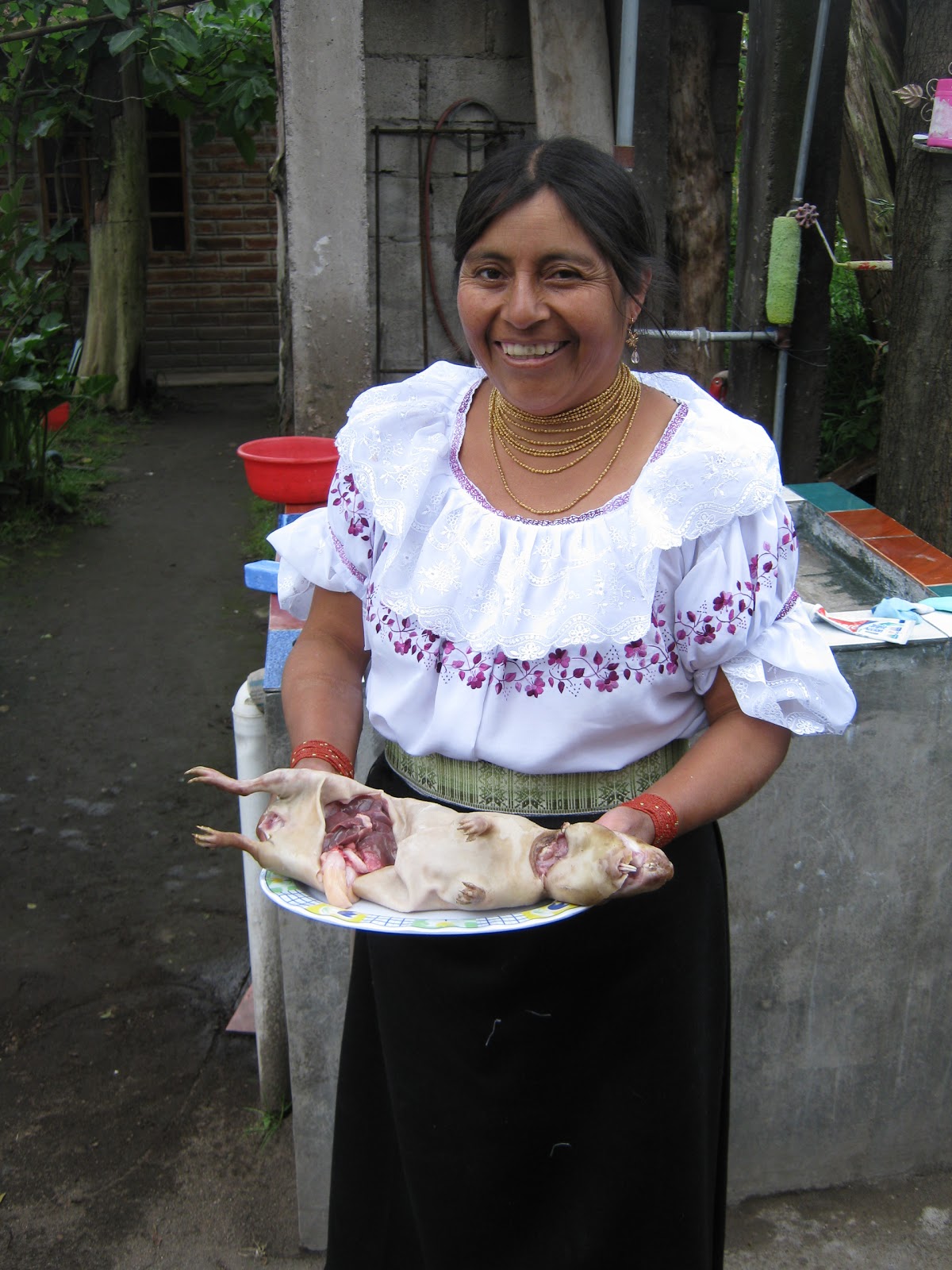
| Preparing the cuy (guinea pig) |
Once the deed was done, Rosa said, "Now the cuy." Cuy, or guinea pigs, are a special food for the Kichwas. We had eaten some at Sisa's baptism, but we hadn't known that the family now kept live cuy in one of their sheds. Rosa picked up a brown and white specimen by the scruff of its neck. She carried it out to the outdoor fireplace. She called Sisa and Yupanqui over, slit the cuy's throat, and let it bleed out.
They had stoked the fire and put a pot of water on to boil. The rooster was so big that all of him couldn't fit into the pot at once. Rosa dunked it in several times and then Aida held it while Rosa plucked off the pure white feathers. It went very quickly. After several more dunkings, all the feathers were off and Rosa peeled the outer skin off the feet. There was a lot of nervous laughing going on the whole time. Rosa and Aida made jokes that Saturday was the rooster's bath day. Then they dunked the cuy into the boiling water and pulled its fur off. It reminded me of the fetal pig that I had dissected in high school biology, but slightly smaller.
Aida talked about wild cuy and rabbits at nearby Lake Cuicocha. I asked if they eat rabbits. "No," said Aida and "Si," said Rosa simultaneously. We all laughed. Aida said she doesn't eat cuy either. "Como todos," said Rosa proudly. Rosa eats everything. Aida said that Yupanqui really like cuy.
 |
| Aida and Rosa joke while they pluck the rooster |
 |
| The cuy is ready to be cooked |
Rosa took both of the carcasses to the sink, where she cleaned them with the laundry brush and gutted them. It was kind of funny to see the two whole animals laying there dead next to their toothbrush, toothpaste, and Head and Shoulders shampoo.
Rosa chopped off the head of the rooster (the Chinese food scene in A Christmas Story came to mind) and then she picked its eyes out.The rooster's heart was huge. She cleaned out the intestines and put most of the entrails aside to feed the parrot, of all things. Eventually the rooster looked "processed" enough that she could have just been preparing a turkey for Thanksgiving dinner. Aida took the meat into the kitchen and started cooking it. Rosa then processed the cuy. Although she gutted it, its head remains on while it is cooked, so it looks rather striking on a plate.
 |
| Sisa writes in her notebook |
We told Rosa and Aida that this was the first time we had ever seen our food killed before. We felt that watching the process was our responsibility as meat eaters. We usually buy our meat neatly packaged in a grocery store, and we are far removed from the visceral emotional process of its slaughter. The fact is that these animals were esteemed pets until the inevitable time came. They were well cared-for and well fed. The animals were respected and appreciated in their lives as well as their deaths. This is what we should aspire to in all of our foods, rather than the factory farms highlighted in such documentaries as "Food, Inc."
 |
| Alpacas |
We had a delicious rooster soup for lunch that day. Rosa told us that roosters are more flavorful than hens. And this rooster had certainly produced a lot of meat; he was huge. After lunch we went for a walk up to the community center. Morochos communally owns around 115 alpacas. They live high up in the nearby mountains. The community shares in the wool that they provide. Several adult and young alpacas had been brought down to the community center today, so we were able to see them. As I approached one, he spit a fine mist right into my face, and I ended up with chewed grass stuck to my sunglasses. Wise guys.
We went to a community football (soccer) game against a neighboring village. Antonio was the referee. The women and kids congregated, chatted, and enjoyed food while the men played. An ice cream truck came (not what we traditionally think of as an ice cream truck in the U.S. This was a pickup truck with a soft serve machine in the back). We bought ice cream cones for 7 people for $1.75. What a deal!
 |
| Sisa and friends enjoy ice cream at the soccer game |
That night, we had the cuy for dinner. As guests, we were given the choicest cuts: the thighs. This was the best cuy we have ever eaten (and it was our third time eating it). It was moist, tender, and tasty. Aida told us that this was a young one, and they are always much better. Older ones tend to be tougher and less flavorful.
The next day was Easter Sunday. In a cultural exchange, we decided to give them a little taste of how children in the U.S. celebrate Easter - with an Easter egg hunt. We had filled 30 plastic eggs with candy and hid them around the yard. We gave Sisa and Yupanqui each a small stuffed Easter bunny, and told them that he had hidden eggs full of sweets outside. After we demonstrated finding an egg and putting it into her plastic bag, Sisa was off. She was excitedly running around the yard, scooping up eggs. Aida took Yupanqui by the hand and led him to some of the harder-to-find hiding spots. The whole family gathered outside to watch, and to help the kids find all of the eggs. It was a lot of fun, and we were happy to be able to show them how we had celebrated Easter as kids. And of course Sisa and Yupanqui love candy. Most of it was already devoured by the afternoon.
 |
| Hunting for Easter eggs |
 |
| Aida and Yupanqui find an Easter egg |
 |
| Steph and Yupanqui |
That night we had a farewell dinner complete with a cake and some Cortez rum. The cake actually said Happy Birthday on it, but was apparently all they could find on Easter Sunday. We were just as happy. Sisa sipped Coke out of a tiny shot glass and toasted with us. Antonio announced that they plan to build a new guest house (separate from the one we were currently staying in) that we are welcome to stay in any time we want to. We were incredibly touched. Sisa presented us with hats and scarves which Aida and Rosa had been crocheting and knitting all week. They then told us they had a question for us. They asked if we could come back in about a year and a half for Yupanqui's baptism just before his third birthday. They want us to be his godparents. We were thrilled and accepted without hesitation.
 |
| Bottoms up! |
 |
| Cake and rum |
 |
| Steph and Sisa |
 |
| Antonio, Aida, and Yupanqui |
At 4:15 a.m. the next morning, the whole family headed into Quito to see us off. It had been a wonderful week, and we are lucky to have been able to spend Semana Santa with our dear compadres. We look forward to returning for Yupanqui's baptism
 |
| Saying goodbye at Quito airport |