Sunday, May 17, 2015

China 2015 Installment #3: Three Gorges Yangtze River Cruise from Yi Chang to Chonqing on the Victoria Jenna


Air China from Xi'an to Wuhan
The next portion of the trip was a river cruise on the Yangtze.  This started with a travel day involving planes, trains, and automobiles (and of course the boat itself). We woke up at 5 a.m. to enjoy the hotel breakfast before leaving for the Xi'an airport at 7:30. Our Air China flight to Wuhan took off on time at 10:10, arriving at 11:40.

Sharp at the Tibetan Restaurant
We were met by Sharp, a very personable guide and driver who drove us from the airport into Wuhan city for lunch at a Tibetan restaurant. We enjoyed chatting with him and getting to know him on the ride and at lunch. After we were finished eating, he drove us to the train station to catch our bullet train to Yi Chang. The station was enormous and immaculately clean.

Wuhan railway station
Bullet train from Wuhan to Yi Chang

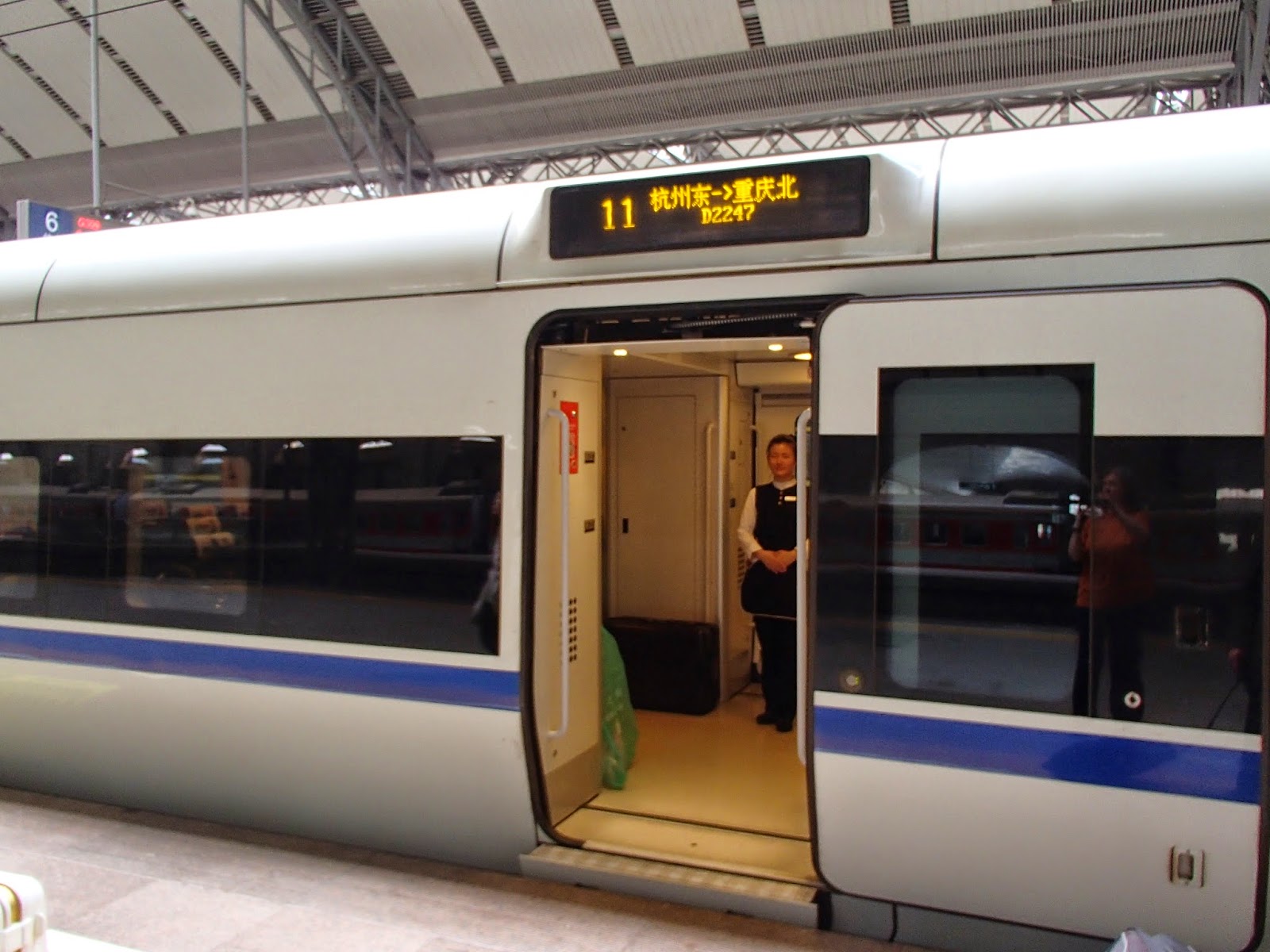
Sharp waited with us until it was time to board the train, and he helped us to get seated in our very comfortable 2nd class seats in car 11. The train was very clean and modern. We left on time at 3:16. The train reached a maximum speed of 199 km/hr (though we hear it makes 450 on other routes), and the ride was very smooth and quiet. I had ridden the commuter rail in Boston a week prior, and the difference was astounding. As we got further away from the city, we enjoyed the rural scenery - rice paddies and farmland. Every station was announced several times in English and Chinese, and there was a sign which told speed, indoor and outdoor temperature, and the next station.

Wen and Craig in Yi Chang
We arrived at Yi Chang at 5:17 p.m. We were picked up by Wen, a cheerful guide who had spent 5 years working in tourism in Taiwan, but came home to Yi Chang a year ago. He was very friendly. We drove about 25 minutes to a restaurant, where we enjoyed a nice dinner in a small private dining room.

After dinner, we drove around 30 minutes to the boat: Victoria Jenna.  It was getting dark and we saw the lights of a 6-deck river cruise ship with capacity for just under 400 guests. We embarked through the lobby on deck 2. The lobby was quite stylish, and we could tell that this was going to be a very comfortable few days.

Embarking on a Yangtze River cruise on the Victoria Jenna
As we checked in, the cheerful staff offered us an upgrade from our standard cabin to a junior suite. We are always wary of the upsell, but we decided to take a look at the two cabins and then decide. We took the glass elevators to each cabin. Both had twin beds, a balcony, and an en suite bathroom, and would have fit our needs fine. But the junior suite was amazing. It had high ceilings, 2 beds, a love seat, desk and chair, large flat screen TV, and plenty of closet / storage space for luggage. It was the same size as a normal hotel room, and even had a full-sized bathtub in the bathroom. Not what I would normally expect on a ship! We decided to upgrade, as the price was very reasonable, especially given that we would be spending four nights on the boat. We were on the 5th deck (only one deck above us)), down the hall from the bar and lounge. We were quite happy with our new space, and it was nice that we would be in one place long enough to spread out a bit.
Our junior suite, #504, as taken in 2 photographs from out balcony

We had expected the cruise to be mainly comprised of western tourists, but it was actually a majority of Chinese tourists. This was nice to see. The boat was not setting sail until the next morning, so we got settled into the room and went to sleep.

We woke up before our alarm at 6 a.m. The boat started to move at 6:45, and we went out onto our balcony in our ship-supplied terry cloth robes to watch as the boat glided through limestone karst-lined gorges, past miniature lighthouses to keep ships at a safe distance. The air was pleasantly crisp and cool with a little breeze. It was very comfortable.
The view from our balcony, Qiling Gorge
We went to breakfast at 7:30, in the dining room on the top deck. We had table assignments, and we really liked our tablemates immediately: Birgit and Stephan from Norway, and Korean-American couple Jang and Yung and their adult son Brian. Jang had lived in Massachusetts for a while, and Brian had studied in Oslo. And yet we all met in China. What a small world!

After enjoying our buffet breakfast while getting to know our new friends, we all went to the English cruise orientation. The American cruise director was quite funny, and obviously adored his Chinese crew. He clearly is a good mentor for teaching the younger employees good hospitality skills. He explained everything and was quite entertaining.  Afterwards, we wandered the decks and went up to the observation deck. There were lots of Chinese tourists sitting up there, and it was like a middle school dance. Men on one side of the boat and women on the other.  A man was playing a 3-stringed instrument while his friends sang and tapped their feet. On deck 5, women played mah jong and men played poker.
Chinese tourists provide musical entertainment on the observation deck
There was an optional shore excursion this morning, but we decided not to participate. We would be going to the Three Gorges Dam this afternoon and through the locks tonight. Part of the point of this cruise was to relax and unwind a bit, so we didn't want to overschedule ourselves. Instead, we went to something much more low-key: a Chinese medicine lecture with the ship's doctor, Dr. Lee. He gave a lecture focusing on acupuncture / acupressure as well as touching on other treatments. This was to be his last voyage on the ship after 5 years of service, and he was offering free treatments for 10 passengers per day, first come first served.

After the lecture we were the first to sign up. Since Craig's MS diagnosis, he has been very open-minded about treatments, and is willing to try anything that is offered to him. He had never tried acupuncture before, and was eager to give it a try. Dr. Lee saw us immediately. We discussed Craig's MS. He said that although the Chinese don't have this disease, he can try to treat the symptoms. After about 20 minutes of interview about Craig's current condition, he said that he thought that Craig's liver and kidneys were weak, so he did acupuncture mainly on Craig's liver and kidney lines (top of feet, inner calf, inner forearm, chest, etc.) He left Craig with the needles in for a while, then removed them and added a few more for shorter time. Craig could barely feel the needles, and they weren't uncomfortable at all until Dr. Lee tweaked the needles a bit, and it caused some brief minor pain.  He then gave him some herbal pills and gave him instruction to take them before every meal. He said to book a follow up appointment tomorrow; he wants to know how Craig feels. He likes challenges and learning about conditions that are unknown to him.
Dr. Lee performs acupuncture on Craig
When we got back to our cabin, the front desk called to say that we had a phone call. A phone call? For us? We hope everything is ok. We went down to the lobby and took the call. It was Wang Jun! It was so nice to hear his voice! He was checking up on how the trip was going so far, and telling us that he and his whole family were looking forward to our arrival in Guiyang in 2 weeks. We were just as excited!

After a lunch buffet with our tablemates (we found out that Birgit and Stephan were in the cabin next to ours), we met on Deck 2 for our excursion to the Three Gorges Dam. We were split into small groups, and ours included Birgit and Stephan, as well as a group of Singaporean tourists who were very friendly. We got off of the boat and took a bus for a short ride to the visitor's center via the Xiling Yangtze Suspension Bridge. At the visitor's center, both the tourists and the bus itself were screened before letting us through to the dam site. First we saw a scale model of the whole project, complete with flowing water. It really gave us a sense of the overall scope of the project. Despite all of the pros and cons of dams, there was no denying that this was a very impressive feat of engineering!
Three Gorges Dam viewed from Jar Hill Mountain

The idea of the dam was first proposed by Sun Yat-sen in  1919. John Louis Savage of the Hoover Dam came in the 1940's to help to realize the project, but WWII halted progress. In the 1950's, 30,000 people were killed in a single flood season. Not only would a dam be capable of generating power, it would also save lives by lessening flood impact, and just generally evening out the seasonal fluctuations of the river. (Before the dam, when water was low, men would physically pull boats along rocky areas of the river to prtovide passage). The Gezhouba Dam was constructed in Yi Chang in the 1970's, and its success gave the Chinese the confidence to embark on the massive Three Gorges Dam project.

Two five-stage ship locks viewed from Jar Hill Mountain

Xiling Gorge was chosen as the site because it is the widest of the three gorges. The exact location was selected because of the stability provided by granite bedrock there, and also the presence of an island to aid in construction (the island is now submerged). The dam was built between 1993 and 2008. It took 28 million cubic meters of concrete to build the project - the largest concrete dam in the world.

The final ship lock

There were 40,000 workers involved the project in 1993 (a whole boom city sprung up to support them and their families), and 2000 still remain.
The only part of the project that is still under construction is the ship elevator, with an estimated completion date of 2018. Although our ship would be too large to utilize it, the elevator would lift a container full of water, so that small boats could avoid the locks.


We went to Jar Hill Mountain for a nice view of the dam. We took 4 separate escalators to get to the top. There was a great view of the dam on one side (it is low water season, so there was no overflow of water as you sometimes see in footage of the dam) and the pair of 5-stage ship locks on the other. One set of locks is for passenger boats, and the other is for cargo ships. They took 9 years to construct. Unlike the Panama Canal, it does not cost anything to utilize the locks. The government owns the project and wants to facilitate trade along the Yangtze. We then walked down to an observation area where we got a good view of the ship elevator. It was all very interesting and the sheer magnitude of the scale of the project was mindblowing.

Three Gorges ship elevator
Getting back onto the boat after the Three Gorges Dam excursion
When we got back to the boat, we took nice hot showers to freshen up and then headed to the captain's welcome reception. We sat at the bar with Birgit and Stephan. We sipped tasty sparkling white wine while Captain Li, who has 43 years of experience despite his youthful appearance, welcomed the passengers. We enjoyed some appetizers and then headed to dinner together. Once again, there was a nice buffet which served a variety of Western and Chinese fare.

Cruise director Dick Carpentier, Captain Li Long Hai, and river guide Steven Xu at the Captain's Welcome Reception
We went to the lounge to prepare for the evening's entertainment, a fashion show where crew members dressed up in a variety of costumes representing the various ethnicities of China. We had drinks with Birgit and Stephan and enjoyed the show. We were seated near a door to the deck, and
at around 8 o'clock,  Birgit noticed that we were parked in front of two large doors waiting to enter the first of the five locks. We headed out on deck with all of the other passengers to watch. It was so amazing! As we watched, the doors opened ("like the gates of Mordor," as Stephan would later say). It took about 2.5 minutes to silently open. Then we passed through the doors into the lock and stopped right before the second set of doors.

Victoria Jenna crew fashion show
We went back inside as the fashion show was starting, but we continued to be distracted by what was going on outside. Looking out the door we could tell that the ship was rising, and quickly! I went out on deck and could see the depth markers on the walls, and I looked down below us at the 95 meter marker. We watched the rest of the light-hearted fashion show, and then the four of us went up to deck 6 and watched the whole process as we passed through the next three locks. We could reach out and touch the slimy walls of the lock; there was not much extra clearance on the side of the ship. It was so cool; we were fascinated by the mechanics of it all.

Touching the wall of the lock...not much clearance!

As the locks filled with water, the weights on the sides made a very eerie ghostly noise. Bats were circling, eating insects in the ship's spotlights.  And a red moon was visible overhead. The evening was a magical blend of nature and engineering. We entered the last lock at around 11 o'clock. Birgit and Stephan decided to go back to their room. We went to our room as well, thinking that we should probably get some rest before tomorrow morning's excursion. But once we got to the room, all we could see from our balcony was the concrete wall of the lock a foot in front of our balcony. The whole experience was so exciting...and this was the last lock before reaching the open river. There was no way we could go to sleep. So we grabbed our jackets and went to the bow of the ship on our deck.
Stephan and Craig as the locks open

The final lock was not as tall as the others.   We went through the final gates and there was the river in front of us. We were done with the whole process at midnight. What an adventure! And the passenger locks had  been closed up until 2 weeks ago, so our timing was impeccable. We wouldn't have wanted to miss this!! (They had bused passengers around the locks, where they had boarded a different ship on the other side).

Small boat ride down the Goddess Stream

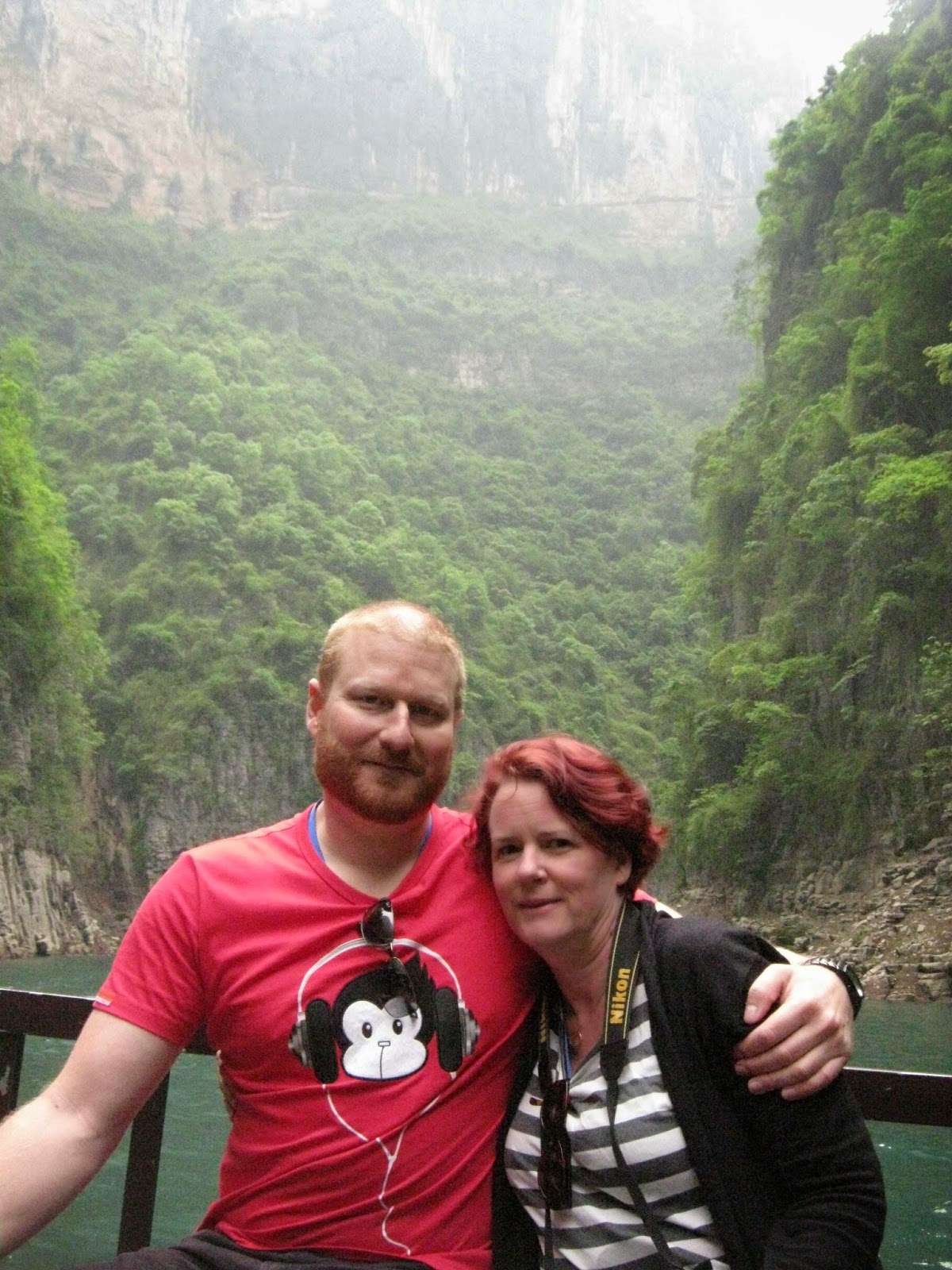
The next morning after breakfast, we disembarked in Qing Shi (in Wu Gorge) for an excursion. Small boats took us through the scenic gorges of the Goddess Stream, a tributary of the Yangtze. The scenery was quite beautiful, but the weather was hazy. I had realized last night that my battery charger for my good camera was broken (and had been for a while, apparently, as the batteries I had been recharging were all dead), so today I needed to resort to my inferior backup camera. Unfortunately, the weather made the lighting very unfavorable for this lesser camera, and the photos don't really do the scenery justice. But we were very thankful that we had brought the old camera, so we were still able to capture our adventures. The scenery was amazing, and we enjoyed visiting with Birgit and Stephan while taking in the beauty of it all.


Stephan and Birgit
Small boat ride down the Goddess Stream

We passed through narrow limestone gorges. You could tell the maximum water level by the height at which the vegetation grew. We saw a cave high up on Shangsheng Peak. This was a tomb of the Ba people, which contained a hanging coffin which was 2-3,000 years old. The boat ride felt like a Disney ride, as our adorable little yellow-tile-roofed boats made up a little convoy through the picturesque gorge. But it wasn't a ride, the boats were not on a track (as was evidenced when our motor briefly stalled).
Craggy peaks of the Wu Gorge
Back on the Victoria Jenna, we sailed through Wu Gorge, the second of the three. Once again, the weather was hazy and photos came out disappointingly. But the weather was warm and we enjoyed being on the observation deck with the other passengers, listening to the commentary of the river guide and enjoying the beautiful scenery. The water was a pretty shade of turquoise. We passed farms with terraced rice fields on the steep mountain slopes. Silhouettes of monasteries could be seen up on the peaks. As we emerged from the gorge, we passed under a modern bridge and approached a "village" where some of the people displaced by the flooding of the gorge for the dam project had been relocated. Only in China would a city of a million people be referred to as a village!

The Kui Gate of Qutang Gorge, and its image on the 10 yuan note
We then had lunch, followed by a lecture about the Three Gorges area.  Next, we sat at the bow of the boat to watch the scenery as we passed through Qutang Gorge (the final of the three gorges). The wind was really howling through the gorge, and it took about 30 minutes to pass through. It was one of the most picturesque, and reminded us a lot of Yosemite valley. Looking back as we passed out of the gorge, we could see the view of the so-called Kui Gate that is pictured on the back of the Chinese 10 yuan note. The thing that surprised us most about the Three Gorges area was that the gorges are much more narrow than we had envisioned.

City wall and white pagoda at Fengjie
Temple at Fengjie
Walking on the city wall toward the White Pagoda at Fengjie

Craig had a follow-up appointment with Dr. Lee, who thinks that the acupunture was not effective for Craig's symptoms, but that the herbal pills had been, so Craig should continue to take them. Then we enjoyed tea and cookies in the lounge. We had once again decided to skip the optional formal shore excursion to Baidicheng, but we did go ashore on our own in Fengjie, to explore for a little while. The late-afternoon sun was now shining and the sky was blue. We walked along a crenolated city wall towards the White Pagoda. The octagonal pagoda is 7 stories tall, and is quite beautiful. There was also a colorful building which appeared to be a temple, and a series of statues of what appeared to be Chinese philosophers next to it. The long rays of the sun cast playful shadows on the wall, and colorful flags flew in the breeze.  We chatted with some locals and made friends with some of their little children. Our self-guided personal shore excursion was quite enjoyable.

Peacock dance, crew cabaret
We had dinner onboard the ship and enjoyed the crew cabaret. Steven the river guide did a performance of Sichuan opera face-changing, which was very impressive, and got us excited for the Sichuan Opera which we would see in Chengdu in a few days. It ended with audience members being brought onstage to dance. I was one of them, and we did the macarena and YMCA. If only Sonam Tshering could see me now! (No Electric Slide though.) We had drinks with Birgit and Stephan on the observation deck. There were very few passengers up there, and we enjoyed looking up at the stars as we sailed along the mighty river.

Sun rising over the Yangtze River
The next morning, we woke up to a gorgeous golden sunrise over the Yangtze. After breakfast, we went ashore for our final excursion: Shi Bao Zhai, which is an island that we could see from our balcony. It houses a Buddhist temple and an architecturally stunning wooden pagoda. The actual ancient city is submerged as a result of the dam project, but the temple sat atop a 120-foot cliff, so it remained unsubmerged. A retaining wall was built surrounding the island to keep the seasonal high water away from consuming the lower levels of the pagoda.

Shi Bao Zhai
The temple was built in the 18th century under Emperor Qianlong. At the time, monks could only climb to the temple via chains attached to the cliff face. In 1819, a 9-story pagoda was built with 11 steps per story (99 steps total, since 9 is a lucky number in Buddhism) to make the ascent easier and less dangerous for the monks who worshipped there. It was built out of mulberry wood for its resistance to insects (it is poisonous to them). No nails were used in its construction. In 1956, 3 more stories were added. The topmost one just has a metal ladder for access. In 2008 following the earthquake, nails were added as reinforcement to strengthen the pagoda.

11 story mulberry wood pagoda at Shi Bao Zhai
View down at the gate and retaining wall from inside of the pagoda
We walked up a hill past shops and through a nice courtyard area to get to the "drunken bridge", with a floor of wooden planks which undulate up and down like a fun house attraction when you cross it. When we reached the island, we had the option to climb the pagoda or not, and we decided to do so. We passed through a fancy yellow gate and entered the pagoda. Inside were statues and altars. We climbed the steep wooden steps, and each story was narrower than the last. Each story contained large round window openings which faced the river. We climbed to the very top, (up a metal ladder through a narrow trapdoor) and had great views back at the ship. Then we walked through the temple which held some interesting statues. We walked down the steps on the back side of the hill, back over the drunken bridge, and back to the ship.

Craig enjoying a beer on the observation deck
Birgit and Stephan kicking back on the observation deck

It was very hot, so when we got back to the ship, Craig enjoyed a cold beer and I took a bubble bath. We went to lunch, and then spent a couple of hours with Birgit and Stephan up on the observation deck. We had the whole deck to ourselves. The sun was blazing down on us.  The hot sun is exactly what Craig should be avoiding with his MS sensitivity to heat, but when we were here in the moment, we couldn't resist the fresh air and beautiful views that the observation deck afforded. But by 3 o'clock, none of us could take the heat for a moment longer, and we retired to our cabins.

Brian, Yung, and Jang
We rested in our room for the remainder of the afternoon, and then went to the Captain's Farewell Dinner. It was the only non-buffet meal of the cruise, and it was quite nice to share delicious family-style food with our table full of friends. Birgit had even convinced the head chef to provide our table with some specially-pepared hot chili sauce to add to the food. Our table was one of the last to leave the dining room, as usual, because we always have so much fun chatting.
Dressed up as Empress and Emperor
Craig and I bought one last drink at the bar, and got our photos taken while wearing Emperor and Empress dress. Then we met Birgit and Stephan on the observation deck to enjoy one last evening together. Tomorrow we would arrive in Chongqing. We would continue on to Chengdu the following day, and they would return home to Norway.

The next morning, we enjoyed a final breakfast with our tablemates, and then disembarked for Chonqing, ready for our next adventure after a very enjoyable river cruise!

Disembarkation in Chongqing

Sunday, May 10, 2015

China 2015 Installment #2: Xi'an


We caught an early flight from Beijing to Xi'an. When we arrived, we were met by our guide Mary. Most foreigners' knowledge of Xi'an stems from the fact that an army of terra cotta warriors was discovered here as part of the massive tomb complex of the first Chinese Emperor.

The warriors were discovered in 1974 when a local farmer named Yang Zhifa dug a well and discovered some terra cotta shards. After further excavation, 8,000 warriors have been found. There were also weapons, including chromium plated swords which could still cut through 20 pieces of paper when discovered. Chromium plating technology was only discovered by the west in the 1940's in Germany. The warriors were commissioned in 221 B.C. by the 1st emperor of the Qin dynasty (Qin Shi Huang) who unified China (the word China comes from Qin). Xi'an was the original capital and the start of the silk road during the Han Dynasty. 720,000 people made the first emperor's tomb 2200 years ago. His tomb is the largest in the world and he started construction when he was only 13 years old. It took 38 years to complete.

After a stop for lunch at a tourist complex where we saw demonstrations of how replicas of the terra cotta warriors are made as souvenirs using the same clay and original techniques, we drove to the location where the warriors were discovered.

On our drive to the warrior site, we passed the emperor's burial mound which looks like a small mountain. It is still unexcavated, partially due to superstition and fear of boobytraps like a mercury lake (the surrounding soil does have high amounts of mercury) and partially due to the desire for better archaeological techniques to be developed before disturbing the site. It is 1.5 miles from the warriors. The emperor chose the spot due to good feng shui with the Mount Li behind it and a river in front.

Mary said that the beautiful sunny clear weather was very rare here. She hadn't seen the mountains this clearly since she can remember. Yesterday there had been a lot of rain. We were very lucky with the weather once again. (the next day she would tell us that today's air quality in Xi'an was the best in all of China! How does this keep happening to us?!)
Pit #1, Terra Cotta Warriors in Xi'an
Fallen warriors waiting to be restored
We arrived at the warrior complex and Mary bought our tickets. We walked through a gauntlet of shops and then took a golf cart to Pit 1, the first and largest to have been discovered. There is a large hangar over the pit, but it has many windows which give sufficient natural light to view them. When you enter, you are in the front of the pit and it is overwhelming in its impressiveness. Everyone is crowding at the front to get the best photos, and Mary helped us get to a very good spot. You could see countless restored warriors and horses. Each of them is unique with individual facial features, expressions, and uniforms based on their rank. The vanguard of footsoldiers were in the front along with their horses. The soldiers were larger than the Chinese at the time in order to provide super-human protection.
A terra cotta warrior under restoration, wrapped in Saran wrap as his glue dries. Pit 1 
After enjoying the view from the front of the pit, we proceeded clockwise around the perimeter. We saw the location of the farmer's well in the front left corner. It is at the very edge of the pit, so if he had dug just a few inches further left, they might never have been discovered at all! The observation platform / walkways were surprisingly close to the warriors, and you could get a very good view. It is still an active archaeological site, and archaeologists were hard at work restoring warriors. Photos were not allowed in certain active areas, and we respected the signs though many tourists did not. Archaeologists were using computers, winches, ladders, etc.in their restoration efforts. Some of the warriors were wrapped in saran wrap as their glue dried, or were belted together. On these warriors, you could see the fractures where the pieces had been joined. When the warriors were first created, wooden beams draped with bamboo mats acted as a ceiling above them. Over the years, some of these collapsed, smashing the warriors into hundreds of pieces. It must be such painstaking work to figure out how to reassemble these pieces, but also very gratifying, as it is so historically significant!
A terra cotta warrior under restoration. Notice how many separate fragments were put together for his head alone! Pit 1
We spent the majority of time at Pit 1, since it is the most extensive. Then we went to Pit 3, which is the command center, discovered in 1976. It is located behind the soldiers in Pit 1, and the officers are facing one another, not in battle formation. No battle weapons were found here, only ceremonial ones. Animal bones discovered here indicate sacrifices for good battles had taken place. There was also a horse stable with fully restored horses, which even had terra cotta tails.
Pit 3 - High ranking officers conferring on the left, horse stable on the right

Lastly, we went to Pit 2, which is not fully excavated. It was discovered in 1976. When the original Pit 1 warriors were excavated, they had been decorated with colorful paint. Upon exposure to the air, the coloration disappeared within minutes (luckily, it was photographed at the time). They are saving some of the rest of the excavation until better techniques are discovered. It looks like the ceiling is still intact, so perhaps the warriors underneath are in good shape. We are glad that they are holding off on some excavation until better technology exists.
Pit 2 - logs and bamboo mats burying the warriors
There were warriors in glass cases that were well lit and we were able to get up close to them from all angles. Mary suggested we spend most of our Pit 2 time here, and she was correct. One archer had a very precise hairstyle and very elaborate shoe treads. The amount of detail was amazing!

Kneeling archer terra cotta warrior in display case in Pit 2. Note the detail on the sole of his show! These archers operated crossbows.
Terra cotta horse and warrior in display case in Pit 2.
In the gift shop, we bought a book and DVD combo pack.The farmer who had discovered the warriors back in 1974, had been nearly forgotten. When Bill Clinton visited the site in 1998, he asked what happened to the farmer, and asked to meet him. They tracked him down, and at that point he was illiterate. They taught him to sign his name, and now he works full time in the gift shop, signing books and meeting visitors who are grateful for his fortuitous discovery. He signed our book and shook our hands, and it was an honor to get to meet him.
Meeting the farmer who discovered the warriors while digging a well in 1974
Then we went into the museum where they have two bronze chariots on display. These were discovered in 1980 in Pit 3. The emperor planned to ride in this bronze chariot convoy to the underworld. These are smaller than life size as it was believed that the soul is smaller than a human. Chariot 1 was for the emperor's bodyguard, and featured an articulated parasol. Chariot 2 (a replica, because the original is on display elsewhere) was for the emperor himself. When it was discovered, it had a sliding window and hinged door which still functioned.

Replica of Chariot #2, the bronze chariot which would take Emperor Qin's soul to the underworld. 
Getting to see the terra cotta warriors was very humbling. The sheer scale and age of them (2200 years!) was hard to wrap our heads around.
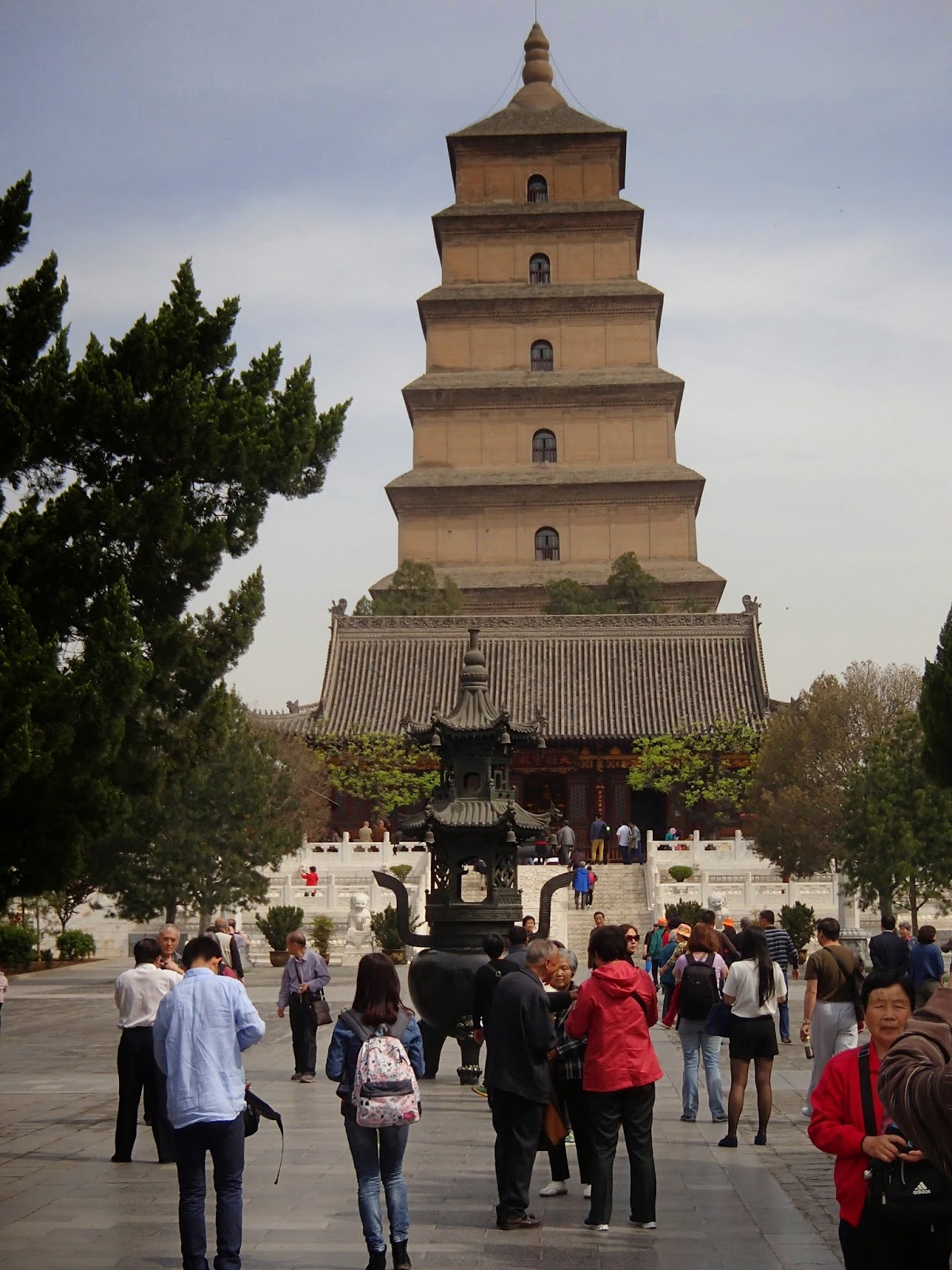
Wild Goose Pagoda
Jade carving depicting seven steps taken by S'âkyamuni (Buddha) immediately after his birth. 
The next day, we visited the Wild Goose Pagoda, a Buddhist pagoda built in 652 A.D. There were various buildings containing Buddhist shrines, and we were allowed to take photos here. There was a hall with three entire walls carved from jade. It depicted the life of the Buddha (known here as S'âkyamuni) - from his mother having a dream of a white elephant which impregnated her, to the baby Buddha taking 7 steps right after his birth, etc. It was beautiful, and had only been carved around 5 years ago. It is nice that this country which has such an historic tradition of art is still creating such magnificent masterpieces, and that it is not a dying art.

Buddhist shrine at Wild Goose Pagoda

Hall of the God of Wealth (note that the ceiling is adorned with oversized Chinese coins)
Next, we headed to the Shaanxi Provincial History Museum, which traces the history of the province from pre-history (1.5 million B.C). through the Tang Dynasty. There were skull replicas of 2 ancient hominids found in the area, as well as replicas of their stone tools. We moved chronologically through the history of Shaanxi, through the Warring States period. (pre- Emperor Qin, who had unified China). Gallery 2 had some gold objects and culminated with some terra cotta warriors. The final gallery featured the Tang Dynasty (Silk Road) and reflected interactions with foreigners. The exhibit concluded with a Buddhist grotto carved from stone, It was beautiful.

Buddhist Grotto carved from stone at the Shaanxi Provincial History Museum 
Next we visited the Muslim Quarter. As the easternmost point on the Silk Road, Xi'an hosted many traders and merchants from along the trade route. Islam arrived in China via the Silk Road in the mid 7th century.The Arabs intermarried with local women, and now, 1500 years later, Xi'an's Muslims are virtually indistinguishable from the Han Chinese except for their dress and customs.
We ate a delicious lunch at a restaurant in the Muslim Quarter. It was a very interesting hot pot, boiling away in a single-serve cast iron pot. It contained beef meatballs, boiled quail eggs, greens, and glass noodles. It was so piping hot that we couldn't eat it for a while, but it was absolutely delicious, with lots of Middle Eastern spices. It almost tasted like some Indian lamb dishes we have had. Craig ate way more than he should have, because of his love of spices and peppers.


A delicious individual hot pot consisting of meatballs, quail eggs, greens, glass noodles, and delicious Middle Eastern spices.
Next we visited the Xi'an Great Mosque, which dates back to 742 A.D. Its architectural style is distinctly Chinese, but with Arabic lettering on the outside and Persian carpets on the floor. Despite being within the hustle and bustle of the Muslim Quarter, the mosque sits in a peaceful courtyard where you can hear birds singing and enjoy the beautiful gardens.
Great Mosque of Xi'an
Next we had a couple of hours to explore the Muslim Quarter on our own. The sights and smells were intoxicating. Men pounded sesame and honey into candy with large wooden mallets. A man pulled taffy by hand using a massive hook on one end. He pulled it out into the street while passersby watched in amazement. A young man stirred a huge pot of peppers and the aroma made our mouths water. Bouquets of wooden sticks sat next to a shish kebab vendor.
Shish kebab in the Muslim Quarter
Bubbling vat of spices and peppers, cooking on the sidewalk in the Muslim Quarter.
On our way back to the car, we ran into several "ugly Americans", who were very disrespectful to the locals. A group of "frat boys" repeatedly shouted obscenities in English, thinking themselves to be very clever, and assuming that nobody else could understand what they are saying. We were disgusted, and Craig gave them such a dirty look that we heard them comment, "Man, those people were pissed!"
We had also overheard a man telling his girlfriend that these people were "Taliban terrorists." She laughed, and he repeated himself. We don't understand why people who are closed-minded and prejudiced against Islam would even bother visiting the Muslim Quarter, if they only wanted to mock it and use it to reinforce their own ignorant stereotypes. Travel is about learning about other people and how despite our differences, we are all human beings. We were ashamed of these countrymen of ours. There weren't a lot of Western tourists, so it was sad that the majority of them were setting such a bad example. Regardless, all of the locals were very friendly towards us and we felt very comfortable and safe wandering around and exploring on our own.
Xi'an Bell Tower
Next we went to the Tang Dynasty Show. The show has been running since 1988, and is a must-see experience. We had seen it featured on Samantha Brown's Passport to China, which aired around the time of the 2008 Beijing Olympics. We started off in the dining room, and enjoyed a "Dumpling Banquet". We were served dumplings shaped like animals and flowers, and they were delicious and incredibly cute as well - I mean, dumplings shaped like hedgehogs?!
Dumpling banquet!
Then we headed into the theater for the show. The show was extensively researched and the costumes, choreography, music, and instruments are authentic to those used during the Tang Dynasty (618 - 907 A.D.) It was breathtaking.
Musicians perform on period Tang Dynasty instruments
There was an instrumental number followed by some dances. The first featured women in dresses with ribbon-like sleeves of ramie cloth which made intricate flowing patterns as they danced. It was so elegant and mesmerizing!  Then there was a wizard dance that reminded us of Bhutan. Next was a dance choreographed by Yang Yuhuan, one of the four most beautiful women in ancient China and the favorite concubine of Emperor Xuanzong. It featured cascading waterfalls.

Flutist and dancer at the beginning of "The Oriole Singing in Spring".

World famous panpipe master Gao Ming performed an amazing rendition of "The Oriole Singing in Spring."

Panpipe master Gao Ming performed an amazing rendition of "The Oriole Singing in Spring." It is said that an oriole had interrupted the emperor's speech one time, and its song was so beautiful that the emperor commissioned this song. There was a warrior dance which included kung fu and acrobatics. The grand finale was the spring festival, where the emperor walks among his people. It started with a very cool dragon dance, with people in dragon costumes as well as dragon stick puppets undulating to the music. The ladies dance and the emperor enters. A woman is carried in on a giant lotus blossom and dances with a sword (similar to the saber tai chi that we witnessed at the sports school). It was a grand finale.
Dancers perform for the emperor. 
Dancer is brought onstage on a giant lotus, and gracefully dances with a saber for the emperor. 
We were absolutely blown away! The production values of the show were top-notch. The scale of the production (number of performers, costumes, lighting, sound quality, narration and explanation of the acts, beauty of the theater itself, and variety of performances) was staggering. It exceeded all expectations and we highly recommend it to anyone visiting Xi'an!
We went back to the lovely Shangri La Hotel Xi'an, and chatted with the lovely staff. We enjoyed our final night in our corner room with two walls of windows. We got a short night's sleep before rising early for our flight to Wuhan to begin our Three Gorges Yangtze River Cruise.

Saturday, May 09, 2015

China 2015 Installment #1: Beijing

After a fantastic trip to China last October with Myths and Mountains, we decided to return to see more of this fascinating country. Our visas were still valid, and very affordable non-stop flights from Boston to Beijing made it irresistable. This trip would start off with some of the popular tourist destinations: Beijing, Xi'an (home of the terra cotta warriors), a Yangtze River cruise through the Three Gorges area, and Chengdu (famous for giant pandas). Then we would cap off the trip with a return visit to Guizhou, to visit our dear friend Wang Jun and his family. We would do some sightseeing in the area, as well as attend a courtship festival of the Miao ethnic minority. I will post the trip in installments based on city.

Here is Installment #1:Beijing.

Our direct flight to Beijing from Boston was delayed by 4 hours, since the plane had been late arriving due to mechanical problems. The Hainan Airlines 787 Dreamliner has very comfortable economy seats. We watched the film "Lost in Translation", which would often come to mind fondly during the course of the trip.

Waiting for us at the airport was our familiar driver from our last trip to Beijing. He greeted us and handed me his cell phone, to talk to our guide. It turned out to be the lovely Karen, who had accompanied us to the airport at the end of our last trip. We liked her very much, and we were excited that she would be showing us around tomorrow. Instead of arriving in the early evening, we finally arrived at the lovely Red Wall Garden Hotel​ at around midnight. We got settled into our comfortable room and got a good night's sleep after our thirteen and a half hour flight.

Arriving at the Lama Temple
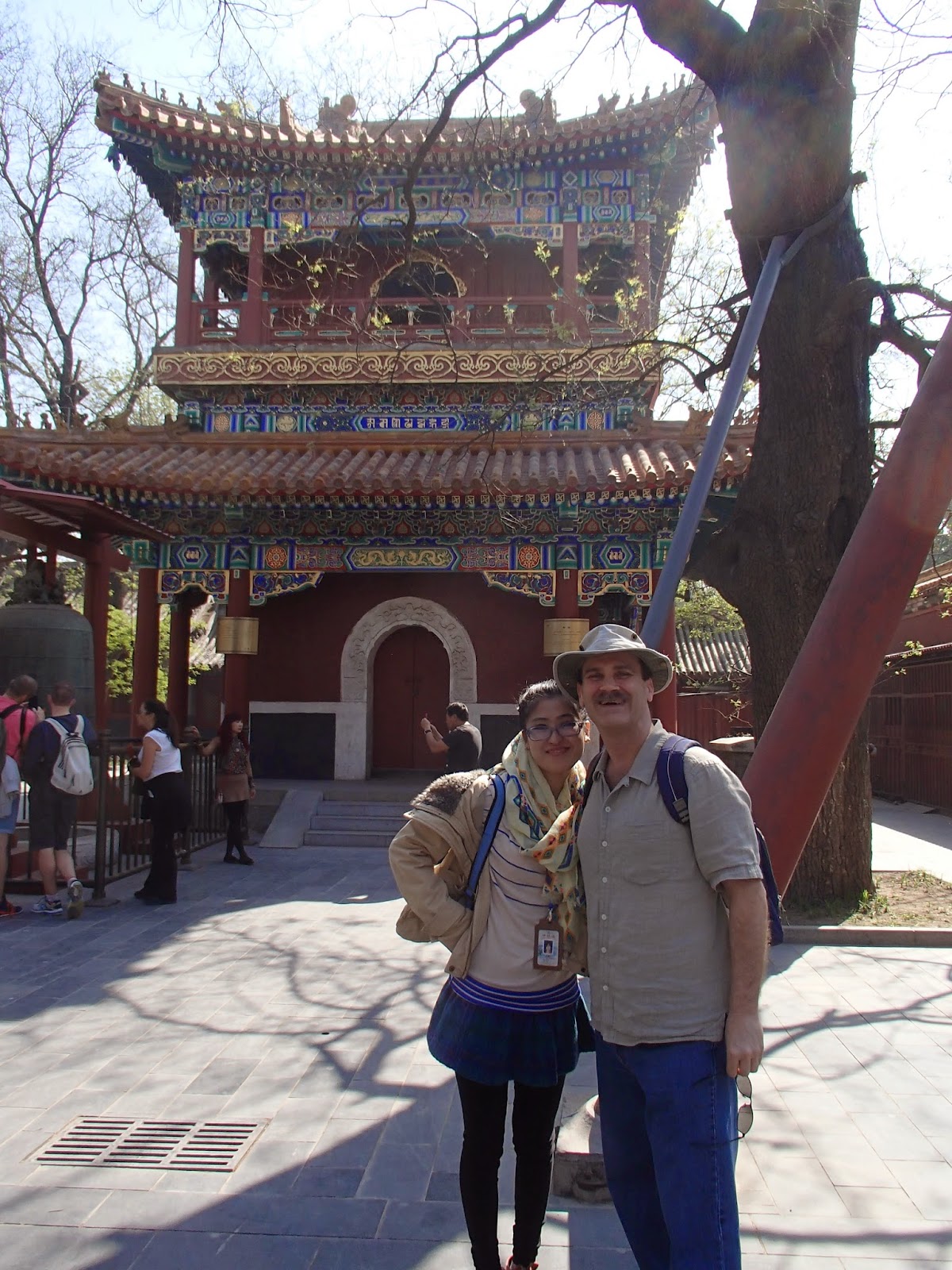
Karen and Craig at the Lama Temple
The next morning we enjoyed the hotel breakfast, and then Karen and the driver picked us up at 9 o'clock. Our streak of gorgeous weather in Beijing remained unbroken, as we had warm sun, blue skies, and clear air. It was the perfect day to explore parts of the city that we had missed last time. We went to the Yonghegong Lama Temple. It was built in 1694 as the residence of Prince Yong of the Qing Dynasty. In 1744, it was converted into a Tibetan Buddhist temple. There are many halls which contain shrines and magnificent Buddha statues. People congregate in plazas in front of each hall to pray and light incense. Monks study in the halls in the early morning and late evening, after the temple closes to the public.

Incense pot at the Lama Temple
Buddhist pilgrims pray and light incense at the Lama Temple

The most awe-inspiring sight here was an 18 meter tall statue of Maitreya carved from a single piece of white sandalwood (in total it is 26 meters tall, as there are 8 meters underground for stability). The tree was cut from Tibet in the mid 18th century. It took 3 years to transport it to Beijing, and then it took an additional 3 years to carve. It was beautiful. Photos were not allowed inside, and although many other people took them anyway, it is important for us to respect the rules. Perhaps not having a photographic image of something so humbling is actually fitting, as Buddhists believe in non-attachment and the impermanence of the material world.


Craig at the Lama Temple

 After a thoroughly enjoyable visit to the Lama Temple, we went to Beihai Park. It is the earliest and best preserved imperial garden in the world, having been established in 1166 A.D. It is 690,000 square meters, including 390,000 square meters which comprise Taiye Lake. Flowers were blooming everywhere, and many families were enjoying strolling along the walkways or taking pedal boat rides on the lake. We crossed a bridge to Jade Flower Island, and climbed up to the White Pagoda, a 40-meter tall stupa built in honor of the 5th Dalai Lama's visit in 1651.

The White Pagoda on Jade Flower Island, Beihai Park
Karen and Steph at Beihai Park
Beihai Park
After a nice dumpling lunch, we visited the Beijing Shi Cha Hai Sports School. No photos were allowed inside. Since this is where many of China's elite athletes train, we suppose that this is a matter of national security. Karen said that tourists generally don't visit here, and it was her first time. It was a very nice campus with many buildings and gardens. The gymnasiums were very modern. We first went into the badminton gym. Boys and girls were playing. They had so much power behind their serves and volleys. It was really impressive to watch them practice.

The school takes mostly local Beijing students, as well as some students from other parts of China, and a small number of foreign students. Students must qualify to be accepted. They pay tuition until they get to a level where they win competitions, and at that point the government will give them scholarships and stipends. The youngest students are only 5 years old. They study academics in the mornings and athletics in the afternoons.

 Next we went to watch ping pong. The age range in this gym went from the very youngest (around 5) to teenagers. After a brief warm up of running, jumping, and arm exercises, they started to play...wow!! Even the little kids were amazing. They were so in the zone. Their focus was so intense. They stood close to the table and volleyed back and forth, and then after a while they stepped further away from the table and continued. They had multiple balls in reserve in their hands so that if one went awry, they just served another one without missing a beat. It was mesmerizing.

Next we went into the boxing gym. There were 2 rings. Nobody was fighting. There were only older boys in this gym. Most of them were jumping rope (sometimes getting two jumps in for each swing of the rope). They punched large and small bags.

Next was Tae Kwon Do, which we watched through windows overlooking the gym from a hallway. They were warming up, and then donned shin guards and arm guards and sparred - sometimes boys against girls. Most of these students were older as well. One boy kept kicking a girl in the face. It looked harsh, and Karen couldn't help giggling nervously.

Beijing Shi Cha Hai Sports School bus 
Next we went to a larger gym where three separate sports were training simultaneously. A group of young children practiced Chinese Kung Fu, doing roundhouse kicks, etc. Despite the discipline required at the school, these were still little kids, and occasionally needed to be directed to stay on task by their coaches.

In the center of the gym, gymnasts (all girls except for one boy, mostly teenagers but a couple of younger girls) practiced. They got into wheel pose and then traveled the whole width of the gym without breaking the pose. Wow! As beginner yoga students, this blew our minds. Then they stepped across the gym, high kicking their legs up to touch their ears. They went back and forth doing this.

At the far end of the gym, a couple of teen girls were doing tai chi with sabers. They were very graceful and the movements were elegant. As we walked through the campus, we saw students playing at outdoor tennis courts, and running laps on a track. The Chinese flag hung in all gyms. It was a very special experience to see this and we are sure that these are future Chinese Olympians for sure!
Women hand-stretching silk batting as filling for comforters 
We visited a silk factory and learned about the production of silk thread and silk batting. Cocoons which contain a single silkworm can yield a mile of silk thread each. This thread can be extracted and wound by machine. Cocoons which contain 2 silkworms can yield silk batting, which must be hand-stretched.

After an enjoyable dinner, we went to see the Beijing Opera at the Liyuan Theatre. It is an art form that dates back to 1790. We found our table. in the front center of the VIP section. We had complimentary tea poured by a guy with a large watering can style teapot with a flourish, along with snacks. An actor sat on the stage doing his makeup at a mirror box, and then a man helped him to get dressed in his opulent costume. We were allowed to photograph this preparation, though there is no photography allowed during the actual show. Once he was all dressed, he bowed to the audience and then walked offstage.

Beijing Opera actor sits on stage to apply his make up
Beijing Opera actor is dressed for a skit called Battling the Armored Vehicles

Karen had explained that there are a number of different skits that the opera performs, usually two or three per night. You never know what you will get. The band was visible barely offstage to our right. On either side of the stage was a screen which contained subtitles in both Chinese and English. Karen had explained that the singing style is old-fashioned and difficult even for Chinese speakers to understand.

The first story was called Autumn River. It had just two characters: a nun named Chen Miaochang and a boatman. It was a very simple story without much complex choreography. The nun hired the elderly boatman to follow her scholar boyfriend Pan Bizheng's boat down the river. There were flutes and stringed instruments played with a bow. The music was also used as sound effects, as they walked or pantomimed being on an unsteady boat. The nun sang in a very shrill voice. The boatman teased her and tried to make her nervous with various delays. He flirted with her and when they finally caught the scholar's boat, the scene abruptly ended.

Our table at the Beijing Opera at the Liyuan Theatre

The second story was called Battling the Armored Vehicles. Military leaders in elaborate robes with flags on the back and platform shoes did high kicks like the gymnast girls. There was very little dialog. General Gao Biao's army fought General Wu Shu's army. There were elaborately choreographed fight scenes with acrobatics on the battlefield. The costumes looked really cool as they spun and twisted and fought with swords and staffs. General Gao pantomimed being on a horse, and jumped and landed (hard) in the splits around 5 times in a row. The skit ended with the dramatic death of General Gao.

We enjoyed the opera very much. We went back to the hotel and got a short night's sleep before our early morning flight to Xi'an. Karen had arranged a breakfast-to-go from the hotel since we were leaving before they began serving breakfast.

We said goodbye to Karen and wished her happy and safe travels for her upcoming trip to the United States, where she would be learning to guide Chinese tourists across the country.

Saying goodbye to our dear Karen at the airport