|
| Pigs on the road |
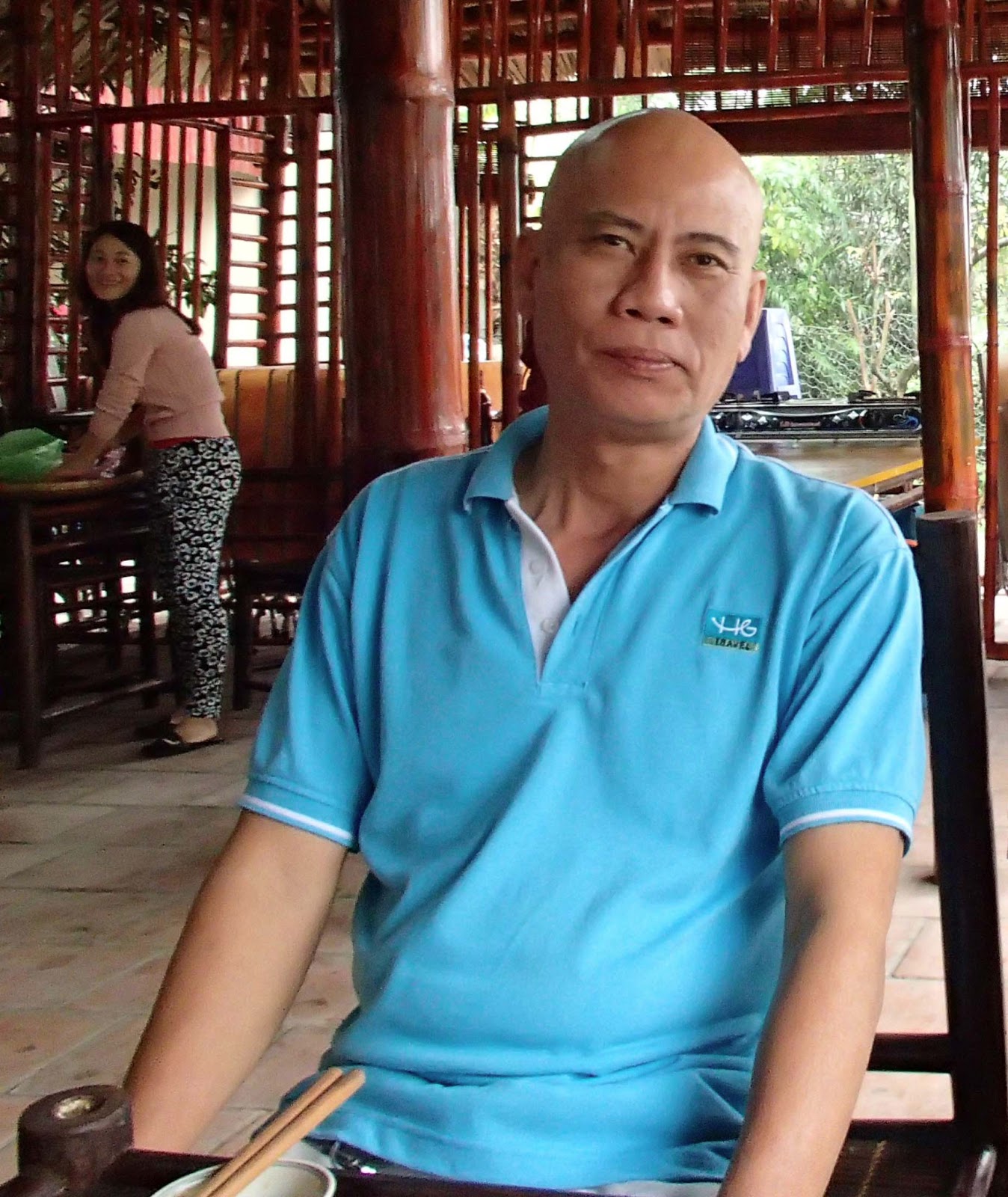
Cuong told us that he personally believes that America was justified in getting involved in Vietnam. He believes that it was altruistic in intent; that rather than becoming involved for selfish interests such as natural resources, we were truly trying to help the country to escape communism, and to stop the spread of communism. Why was this so important? How bad was communism, in his opinion? "While I was in the jungle for five years, fighting for their cause, the communists put my mother into jail," Cuong explained. Cuong's parents had 12 children. His mother had managed to save up some money for the marriages of her 12 children. When the government found out about it, they demanded the money. She would not relinquish it. After the American POW pilots were released from the Hoa Lo prison (sarcastically nicknamed the Hanoi Hilton), they imprisoned Vietnamese dissenters there. Cuong's mother was held there for 4 months and 16 days. His father protested with a sign that said their son had been fighting for the VC for years, and their reward is to have his mother imprisoned. Cuong's father was beaten up because of this. In the end, Cuong's mother got to keep the money. Cuong and his parents are tough individuals.
He then told us stories about ex-soldiers and their families (both Vietnamese and American) who have returned to the battlefields to try to come to peace with what happened there. He then told us about a film called Wandering Souls of the VC. In it, an American G.I. shoots a VC soldier. He feels very guilty about it and takes the man's belongings home. It tears him up inside for years. His mother's dying wish is that he returns to Vietnam to try to find some peace. He does this, and finds the VC soldier's family. The family had been told by a psychic that theiur son had deserted his unit and was now living in the United States. The family had been disgraced and shunned because of it. They were so happy to hear that their son had actually died a hero's death. The G.I. took them back to the jungle and the place where the killing took place. They found a body there, along with a little ceramic container which had the man's name and death date written inside (what the Vietnamese used instead of dog tags). The psychic had thought that he was in the United States because that's where his belongings had been. The meeting brought tremendous closure to both the American and the Vietnamese family.
Cuong himself has taken American Vietnam vets on trips (such as on motorbikes along the Ho Chi Minh Trail) and said that it is cathartic for everyone involved. Former enemies (neither side of which really wanted to be fighting one another) can come together as friends, each knowing that they were victims of their government's disagreements, and it was nothing personal.
Cuong and some of his brothers-in-arms (a couple of whom had been at his house last night for his birthday) went back years later to try to find a friend's unmarked grave. Like many Vietnamese, they enlisted the help of a psychic to determine where to look. They found the place, stuck a chopstick into the earth, and were able to balance a raw egg on top of the chopstick for 8 minutes. They are sure that this was a sign that they found their friend's grave. They lit a cigarette and stuck it into the ground, and the cigarette let off smoke as though their friend were smoking it.
We were jerked back to the present from these riveting tales as Mr. Giang pulled over at a little roadside store. Two young men were sitting at a table having drinks, and they were quite interested in us. We used their restroom in their back yard. It was a little three walled structure that left you somewhat exposed to the courtyard, but at least it contained a nice western toilet!
After our pit stop, we then then continued on our way. As we crossed over a bridge, we saw a motorcycle in front of us which was pulling a small trailer containing three large pink pigs. We saw where houses had been built on both sides of a dike. This seemed precarious, but Cuong said that there were enough dams nowadays that flooding wasn't that much of a threat.
 |
| Craig and Mr. Giang at lunch |
As we drove further we started to see small mountains punctuating the green landscape. The road turned from pavement to dirt, and it got dusty. We saw tea plants blanketing the hillsides. We passed ferries and dredges on rivers. Individual wooden plies that will later be made into plywood were drying on the side of the road. Straw was also drying in this manner before being made into brooms. We passed lychee orchards.
 |
| Tea plants |
It turned out that we were quite close to the homestay, and we arrived there at around 4:30. The homestay wasn't in a family's house, per se. It was a guest house in a village of the Tay ethnic minority. It was built in the same style as the local houses...a wooden house on stilts with a thatched roof. The guest house had an addition off the back which contained a modern kitchen and western-style bathrooms.
We peeked at the space under the house. The area that was normally used to keep animals was here being used to store bicycles and sheets of corrugated metal.
We left our shoes outside and climbed the wooden staircase to the main floor of the house, which consisted of one big open room. There were curtains around the perimeter which sectioned it off into little private chambers, each containing a mattress on the floor, a duvet, and a mosquito net covering it. We got settled into our space, realizing that there were electrical outlets where we could charge batteries, and we even had our own little electric fan to keep us cool. We then headed outside for a walk with Cuong to take advantage of the late afternoon light for photos..
 |
| Tay Guest House |
We heard music emanating from a traditional Tay house down the dirt road from our guest house, and we saw a steady stream of people going in and out. Cuong talked to the people and learned that they were having a funeral. We were all invited in, so we took off our shoes and headed upstairs into the dimly lit house. Men were playing shrill little horns while others banged drums with heavy wooden drumsticks as they played a dirge. A coffin bedecked in colorful decorations was sitting in the middle of the room. There was a large floral arrangement stood in front of a casket festooned with brightly colored paper shapes. Ritual trees (made of small tree branches wrapped in colorful paper and bearing paper flowers) hung over the casket. Everyone in attendance smiled at us and came over to shake our hands. The family considered it to be a good omen that foreigners had shown up to pay respect to their dead relative. They encouraged us to take pictures. We felt that this was vaguely inappropriate, but we did want to document this interesting cultural tradition, so we took a couple of minutes of video footage.
Cuong talked to the family in Vietnamese. They told him that in the past, Tay people had at times resorted to cannibalism, feasting on the bodies of the dead. As years passed, they developed alternate traditions: over the course of three days, they slaughter one water buffalo and four pigs. This is enough food to feed the entire village, and symbolically distracts them.
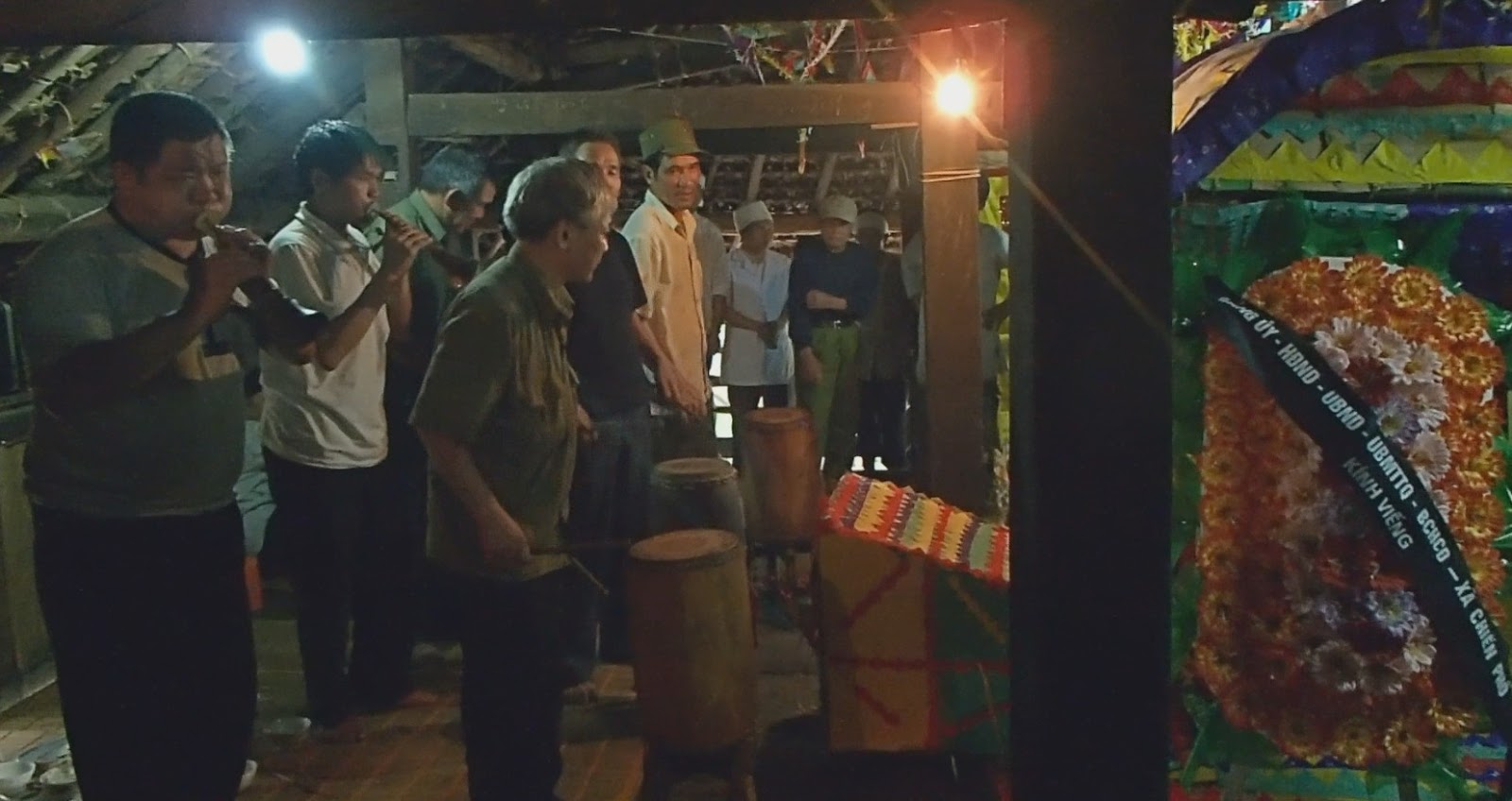 |
| Tay funeral band |
 |
| Tay casket and ritual tree decorations |
 |
| Steph and Craig with Chuong's "Hero Mother" (photo courtesy of Cuong) |
 |
| Rice paddies |
We looked around the house, which was a single large room, similar to our guest house. A piece of slate was inlaid into the wood floor and a small wood fire burned on top of it. There was a wooden rack above the fire, and the man had placed reed baskets up there; apparently smoking them above the fire like that protects them from being eaten by insects. The man told Cuong that he had been in the army for 12 years, and that he was now a carpenter. He had made the house himself and was in the process of building one next door for his son.
 |
| Tea with the carpenter |
Two women were preparing our dinner in the modern kitchen. They smiled and giggled as I took their photos. Vegetables were soaking in plastic bowls and buckets. Pots simmered on a gas cook top. It turned out that these two ladies ran this guest house as well as another one next door. They prepare all the meals and set up all the beds and mosquito nets, etc. They were incredibly friendly, always smiling and giggling. A little gray cat wandered around the guest house, meowing for food at the kitchen.
 |
| Craig, Cuong, and Steph at dinner in the guest house |
Soon our whole table was completely covered by food, and it all was beautifully presented. It had all been prepared with so much care. Everything was delicious! And they had seemed to whip it up so effortlessly.
Mr. Giang poured us each a shot of rice wine from a plastic water bottle. It was surprisingly smooth. He and Cuong taught us the Vietnamese phrase for cheers: "chuc suc khoe" (pronounced "chook sook kway"). Cuong and I each stopped at one, but Craig and Mr. Giang refilled their shot glasses several times. After dinner, we left the table and had tea at the little sitting area. We chatted and had lots of laughs.
At around 9 o'clock, we said our goodnights and ducked behind our curtains and under our mosquito nets. It was warm, but Craig turned our electric fan on to keep the air moving. The duvet was too warm to wear, but it was soft to lay on top of. We used our cotton sleeping bag liners for covers and
drifted off to sleep.
At 6:30 the next morning, we woke up and got our backpacks ready for a day hike. Our cheerful hostesses (who sleep on-site) had already prepared an elaborate hearty breakfast: fried eggs, baguettes, crepes, bananas, and coffee. Cuong and Mr. Giang each had a bowl of ramen noodles with a fried egg in it. A young man named Chuong came over from next door (we later learned that he was the son of the lady we had met yesterday with the black teeth) to be our hiking guide.
 |
| Our canine buddy |
 |
| Woman carrying a basket of ducklings |
 |
| A bike amongst the rice paddies |
As we set off from the guest house, the resident dog (a very friendly and low key fellow) decided to accompany us, which was nice. We walked on paths between rice paddies. It was a gray, drizzly day, but that just made the rice plants seem a more vibrant green. We could see the nearby mountains and hills reflected in the standing water in the rice paddies.
We passed a woman who was shouldering a pole with baskets dangling off each end. She was wearing traditional Vietnamese conical hat. I peered into one of the baskets to see about a dozen ducklings she was transporting.
 |
| Rice paddies |
Even in schools with predominantly ethnic minority students (in this case Tay), the teachers are usually ethnic Vietnamese, which was the case here. This particular school went through 5th grade. Students learn English starting in 3rd and 4th grades. We were walked across the schoolyard and entered class 2B. The kids' desks were in small clusters of 4 or 5, which the teachers said is a new method here. I peeked over one small girl's shoulder into her notebook. Her handwriting was small, neat, and very precise, incredibly refined when compared to the handwriting of American second graders.
 |
| Visiting the local school (photo courtesy of Cuong) |
 |
| Hiking in the rice paddies (photo courtesy of Cuong) |
The weather was humid, especially when the rain stopped. We passed a traditional Tay house under construction. People in the community come together to help one another with building projects like this.The owner of the house is required to feed the people who help (similar to the Ecuadorian concept of a minga). Cuong talked to the men building this house out of timber hewn from trees that they themselves cut down. The house's stilts are set onto concrete footings. While we were there, the workers were taking a break from the rain, huddled around a water pipe through which they smoked tobacco.
Cuong told us a bit about Chuong's family history. His mother (the lady with the black dyed teeth that we had met yesterday) had only known Chuong's father for 15 days. After that, he was sent off to war and killed. She had had to raise Chuong alone, and was known in Vietnamese society as one of the "hero mothers" because of her sacrifice. It was the belief of the VC that having sex during the time of one's military service would ultimately lead to their deaths. Whether this was superstition or a way for the commanders to keep control of their troops is unsure, but Cuong told us that it held true 94% of the time.
 |
| Gaining some elevation |
 |
| My motorbike driver |
 |
| The "short cut" through steep rice paddies |
I looked around and found myself in the middle of a dirt road. On one side of the road was a house where two men were working on their motorcycles. They didn't take notice of me. On the other side of the road was a small school with a thatched-roof wooden house and a Vietnamese flag in front of it. I sat down on a rock, wondering how long I would be here before the boys showed up. If they followed the route we had taken, it would be a while. I took out my journal and began to write. A group of young children (probably around 4 and 5 years old) came out of the school. They all stood across the street, peering down the hill at me. I smiled and waved. They giggled but hung back. Almost all of them were wearing the same white plastic flip-flops that they had at the guest house. Most were way too big for the kids, and I was amazed that they didn't trip. Other kids were wearing rubber boots. One brave girl came down to meet me and smiled while I took her picture. I showed her the image and that gave all of the other kids the courage to approach me.
One of the men working on his motorcycle approached me and looked over my shoulder at what I was writing in my journal. He smiled and encouraged the kids to pose for a picture. The kids were all giggling and mobbed me trying to see the pictures. They were no longer afraid, and rubbed up against me, looking at my notebook and camera. I also took some video and showed them. It was a lot of fun and helped the time to go by quickly while waiting for the guys.
After 40 minutes, I heard someone call hello, and I turned around to see Chuong, followed by Craig and Cuong, emerge from behind the house. I was surprised that they had come from a different direction. "Short cut," said Craig and Cuong, rolling their eyes. Apparently, Chuong had led them straight up the terraces of the paddies rather than via the road. Even Cuong had found it difficult. They assured me that I had done the smart thing by taking the motorbike.
 |
| Steph's welcoming committee of schoolchildren in the Yao village |
 |
| Yao schoolgirl |
Then we walked across the street to a Tay-style house where we would eat lunch. Under the house was an area where they kept their animals. We saw chickens and baby chicks, piglets, and water buffalo. We took off our shoes and climbed the stairs up to the main level. A woman in an orange and green headscarf welcomed us to her home. The house had the same kind of slate floor inset for the fire that the carpenter's house had had; a traditional kitchen. Above the fire hung flanks of smoked pork, and seven frogs which had been pierced through the skulls, their legs dangling down over the fire. Pieces of furniture were arranged along the perimeter of the house. There was a sitting area with wooden chairs in front of a television and a refrigerator. Along other walls were shelves on which were stored dishes. There was an ancestor altar where incense was burning.
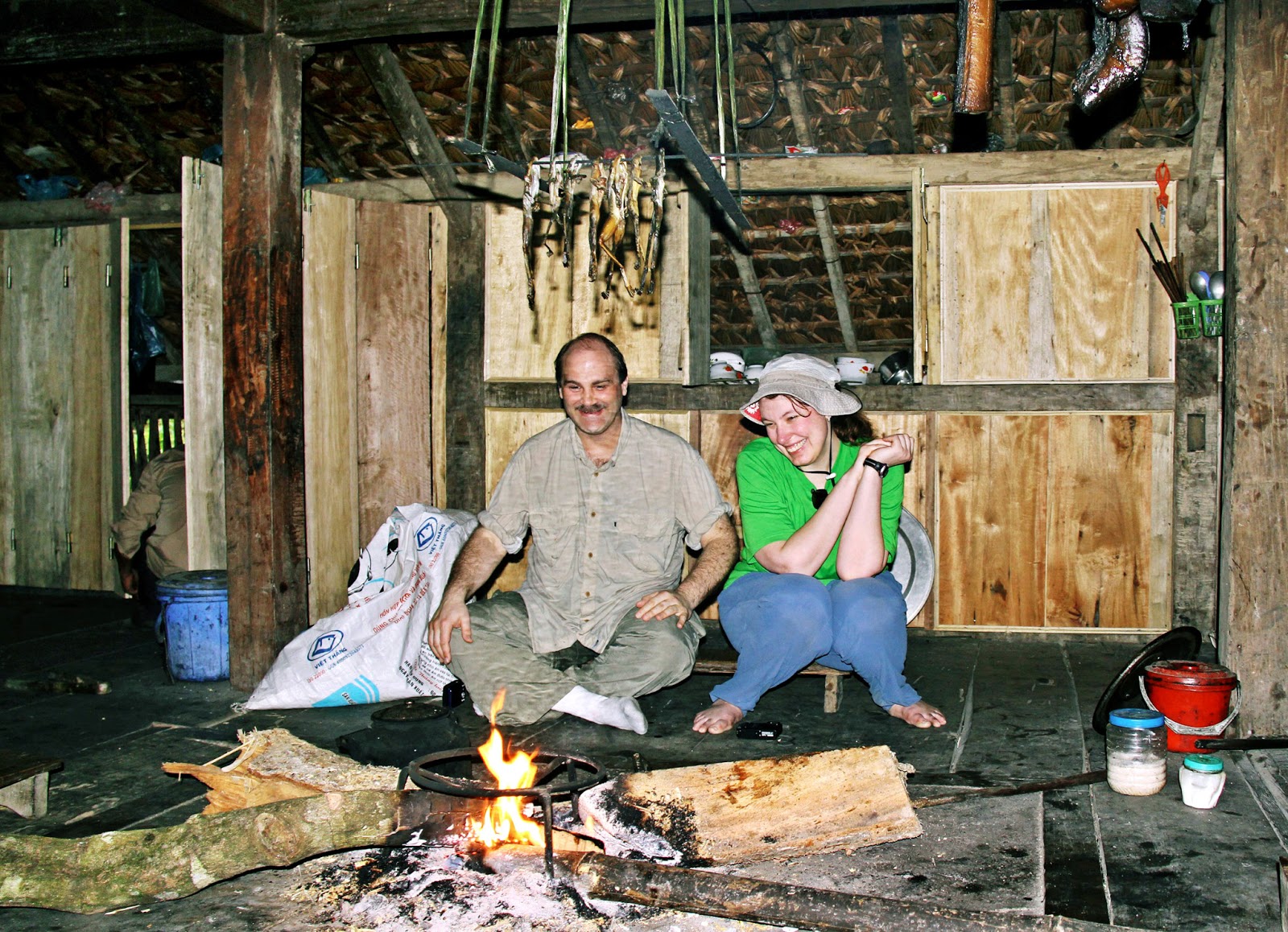 |
| Sitting around the fire before lunch (photo courtesy of Cuong) |
 |
| Chuong serves lunch |
A mother cat and kitten skulked around the house, climbing up bags of rice and scampering near the fire. Chuong prepared our lunch. He took provisions out of Cuong's backpack and also took down one of the smoked pork flanks hanging above the fire. He hacked some meat off with a machete and then cooked it in a wok over the fire.
The woman's 14-year old son came home from school, and went immediately over to the little seating area and turned on the TV. He was fiddling with his cell phone and Cuong told us that his son Phong was the same age.
 |
| Mother cat approaching the fire |
 |
| Lunch with the Yao family |
We all sat together on a mat in the middle of the floor for a lunch of sticky rice, smoked pork, hard boiled eggs, and greens. The smoked pork tasted like thick bacon and it was quite flavorful. Although I had been doing well eating exclusively with chopsticks since the trip began, I was particularly klutzy with them for some reason today, and it gave the family a good laugh and worked to break the ice a bit. A mother cat and her kitten scampered around the house. For dessert, we had white dragon fruit (the fruit whose pink variant we know as pitaya in Guatemala) and oranges. The mother and son enjoyed some candies that Cuong had brought for them. After lunch we sat around the fire once again and enjoyed a cup of tea.
Cuong declared himself "the Dictator" and made the decision that we would be walking back down to the guest house via the road. It was raining out again, and the road was now much too slippery to try to catch motorbikes back to the guest house. It was also too slippery to attempt to descend via their shortcut. So the Dictator decreed that safety came first, and that we would walk down via the road. Our doggie friend had hung out with the animals under the house while we were inside, and he was ready to accompany us when we left shortly before 1:30.
Cuong complained about the roads being in such poor shape. He said that the government creates roads to these remote villages as good public relations opportunities. But in actuality, they don't maintain the roads and it winds up causing potential for erosion and mud slides during the rainy season.
On the way down the slick roads, we encountered a white water buffalo on the side of the road. The dog decided to chase it in good fun, and the buffalo freaked out and started running up the hill as fast as it possibly could. Who knew that a water buffalo could move that fast? The dog chased it until they were out of our line of sight. We kept walking and the dog eventually caught up with us.
At around 3 o'clock, we reached the road and Cuong called Mr. Giang to pick us up and take us the last few minutes. Cuong spoke to the hostesses at the guest house and soon they had filled up three little cedar tubs with boiling water in which we were to soak our tired feet. Our dog stretched out on the porch as we soaked our feet sitting under the house. Some of the neighborhood kids came by, and Cuong presented them with some school supplies.
 |
| Soaking our feet (photo courtesy of Cuong) |
We then went upstairs and enjoyed some coffee and a tin of Danish butter cookies. Craig and I each shuffled over to the bathrooms in the white flip-flops and took nice, warm showers. A young French couple arrived for dinner. They were actually sleeping in a neighboring guest house, but we all ate in our guest house. For dinner we had pork, egg, and onion patties, chicken with lime leaves (a very popular Vietnamese way of serving chicken), pumpkin fritters, tiny shrimp, chicken curry broth, and tofu. It was absolutely delicious. Mr. Giang produced some bottles of rice wine and poured it into shot glasses for us. "Chuc suc khoe!" we all toasted. We even got our happy hostesses to partake. After they took the shots, they shook our hands, as is apparently the Vietnamese tradition. "We've just started," proclaimed Cuong, as he, Craig, Mr. Giang, and I had another round.
 |
| Chuc suc khoe! Craig, Mr. Giang, and Cuong toast |
 |
| Chuc suc khoe! Cuong and Steph toast. |
We had a lot of fun tonight, and there were lots of laughs. Mr. Giang performed some martial arts moves with his shot glass as I recorded some video. "Chuc suc khoe!"we all shouted in unison. Cuong retreated to his cubby, which we dubbed the "Dictator Suite" while we stayed up a while more with Mr. Giang. We went to bed at around 9:30 and slept well after our day of hiking.
The next morning we got up at 6:30, packed up our things, and joined Cuong and Mr. Giang at the table for breakfast. Our hostesses served us crepes, bananas, fried eggs, and baguettes. We ate until we were almost full, and then they brought us each a ramen noodle bowl. They served us so much food. We didn't want to be impolite, so we ate as much of the noodle soup as we could. We washed it all down with coffee. Any coffee that Cuong has prepared for us on this trip had been G7 3-in-1, a surprisingly good (and popular) Vietnamese instant coffee which comes in packets that contain coffee, creamer, and sugar.
By 8:00, we were packing up the car and saying goodbye to the two women who had taken such good care of us for the last couple of days.
 |
| Our guest house hostesses |
As we drove out of Ha Giang City, we drove by a gorgeous bamboo waterwheel. We passed into the Dong Van Karst Plateau Geopark. We knew this because of a large sign announcing it, kind of like the Hollywood sign. We started to see conical limestone mountains (karst) rising around us. The road became very windy as it carried us up over the mountains, around hairpin turns. As we wove our way around on these roads, Craig got a bit queasy. He had realized too late that he should have taken some motion sickness medication.
We stopped at a roadside market. Cuong informed us that we would see 4 different ethnic minorities at the market: Tay, Nung, Yao, and Hmong. Each group had their own distinct traditional clothing style, along with accessories such as head wraps and silver jewelry. Men loaded live chickens onto their motorbikes. Women cut apart slabs of tofu and packaged them expertly in plastic bags without breaking them. People shopped for fruits and vegetables and carried around their purchases on their backs in baskets. People carved pineapples into the elaborate shapes in which they always seem to be served at every restaurant we have been to.
 |
| Woman in traditional clothing at the market |
 |
| Woman selling peanuts at the market |
 |
| Buying a chicken |
 |
| Sugar cane for sale at the market |
After enjoying the sights and sounds the market, we got back into the car and continued on our way even further north. It had become foggy and the roads were dangerous. But as usual we trusted Mr. Giang's ability to transport us safely. We were driving on mountainous roads, working our way up to Heaven's Gate pass, with an altitude of 1100 meters. The road then descended down the other side of the mountain.
 |
| Sawtooth karst pinnacles |
When we stopped for lunch at the Minh Hai restaurant in Yen Minh, Craig located his motion sickness pills, took them, and soon felt better. For lunch we had fried tofu, spring rolls, green beans, chicken with lime leaves, baby pumpkin stuffed with meat, and pork wrapped in the kind of leaves that Cuong used to eat when he was in the army living in the jungle. These were really tasty, and the leaf became crispy and added to the texture of the dish. We had tiny bananas for dessert.
We got back into the car and continued our drive toward Dong Van. We were seeing more and more karst mountains, and if you looked carefully, you could just make out people up on the steep slopes, trying to farm in most inhospitable conditions. The central highlands and the south of Vietnam provide excellent land for farming, which belongs to the ethnic Vietnamese, the majority population. The ethnic minorities are for the most part confined to the north near the China border, where the landscape is mountainous and the soil is rocky. We saw small brush fires burning in an attempt to clear some of the land for farming. We passed some trees which had no leaves on them but their scraggly branches hold on to one or two red flowers. Occasionally, we would see these flowers in the road.
 |
| White Hmong plowing rocky slopes |
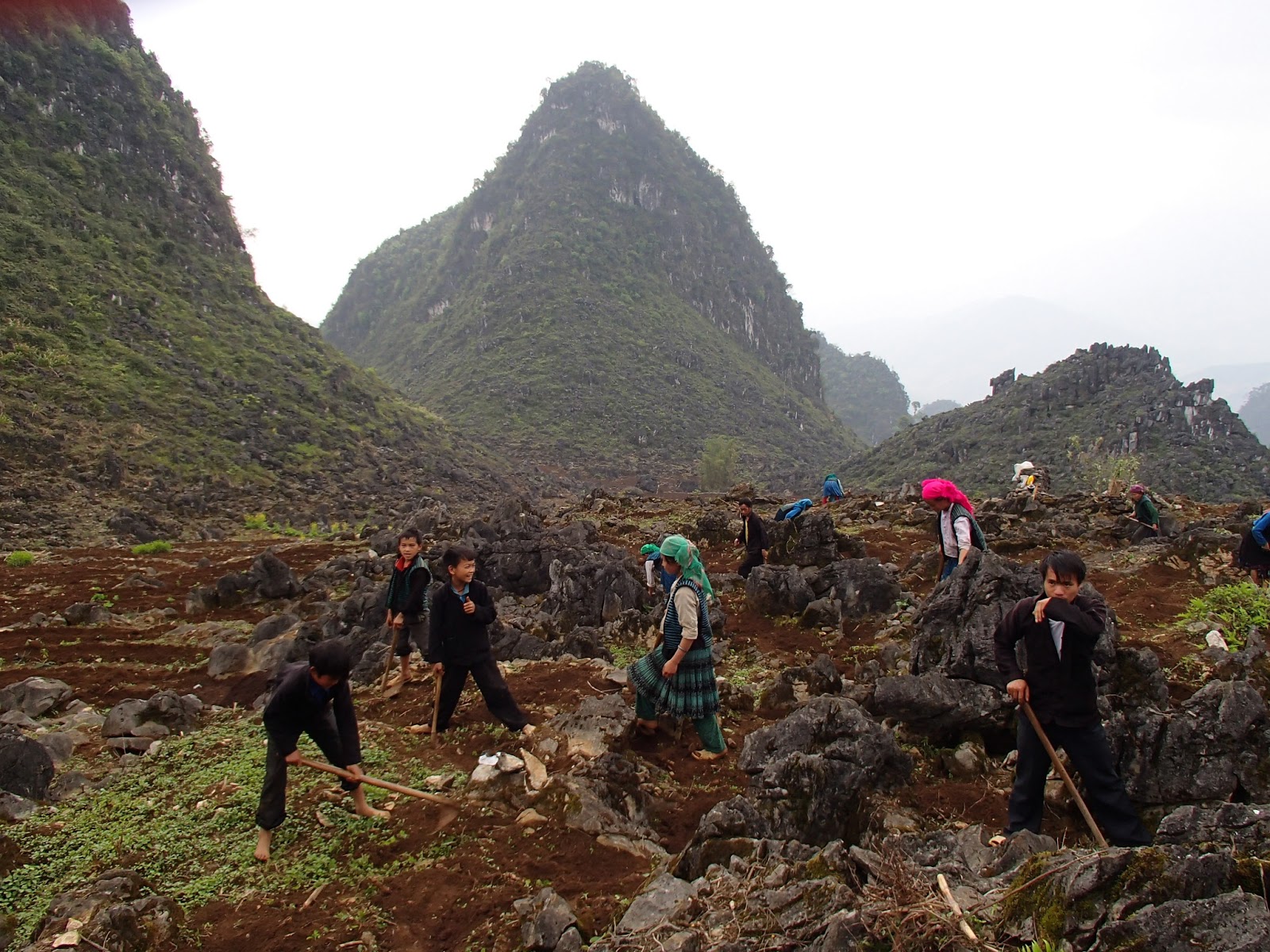 |
| White Hmong families planting corn on rocky slopes |
 |
| White Hmong families planting corn on rocky slopes |
Being from New England, where corn fields are flat, we were quite surprised to see corn being planted this way. This land looks unusable, but these people are struggling to get it to produce corn. Everywhere we stepped, we felt like we were in their way. They were tilling every inch of soil, all while smiling, waving, and talking to us through Cuong.
After spending some time observing their multi-generational work ethic, we got back into the car and continued on, seeing the ribbon of road clinging to the side of the mountains. Though the karst rocks look black on the outside, we saw many places where it had been chopped up to make stone walls, and the inside was light gray or brown. In the distance, the karst peaks took on a sawtooth appearance. We passed over a large river valley.
We stopped at a lookout point. There was a group of Vietnamese men, some of whom tried to sneak a picture of us with their iPhones. Craig noticed this and posed for them, and they got embarrassed. Two other men came up and asked if they could get their pictures taken with us. Only knowing a few English phrases, one of the men said "Happy happy!" as they waved goodbye to us. They all hopped back into their fleet of cars. Cuong could tell from their license plates that they were military.
Around mid-afternoon, we arrived in Dong Van. It is a city situated within the towering limestone karst pillars. We checked into our hotel, a former government guest house called the Rocky Plateau Hotel. We had to leave our passports at the front desk because they needed to be checked by local officials (you need a special permit to travel in this northernmost region).
Toni had warned on the itinerary that "this [hotel] is a very simple place and not immaculate." This set our expectations appropriately. The room was fine, it had a comfortable bed and a clean bathroom. It even had a flat screen cable TV and a mini-fridge. But the glory days of the hotel were most definitely behind it. The rugs were stained, and the paint was scuffed and chipped. There were lamps placed strategically around the room, but only one contained a light bulb. Ugly dated still life artwork hung framed on the walls. Each painting had its own gallery-style light fixture above it, but none of the light switches seemed to operate them. The room was fine...but a bit shabby.
 |
| Karst mountains tower over Dong Van |
Cuong took us to the Pho Co Cafe, a hundred-year-old merchant's house built in the Chinese style, which is now a coffeehouse. We entered the dark wood building with its red paper lanterns. The interior had incredible dark woodwork and an open-air courtyard. There were small bamboo lanterns. The style of the building reminded me of the Chinese house on display at the Peabody Essex Museum at home. We sat down and Cuong ordered us coffees. The young man working there had a modern haircut and western clothes. He sat beneath a blinking electric sign and the contrast between the present and the past was striking. He suggested that we try the frozen mango smoothies, so we ordered a round of those as well. When the coffee came, Cuong called it "patience-training" coffee because we had to wait for it to drip through a metal filter down into the cup.
 |
| Pho Co Cafe, a Chinese coffeehouse in Dong Van |
 |
| Pho Co Cafe, interior |
 |
| Baby Duc and his mother, who invited us in for tea in Dong Van |
 |
| Cuong enters a house in Dong Van's old quarter |
As we continued walking through old town, we passed some kids in the street who were kicking around a badminton birdie, a variation on hacky sack. We were invited into another house. Both the mother and the father were in the military and had various military citations hung up. They were cooking dinner, and they had a little boy who was shyly watching us, shrieking and giggling if we ever looked at him.
We passed a house that had drunken singing emanating from it. Cuong joined in the singing from the street, and one of the inebriated men came running excitedly out of the house. He couldn't believe Cuong had just shown up out of nowhere singing in a strong, confident manner. The two of them continued singing together and the man enthusiastically shook Cuong's hand. The man's adorable mother appeared and she spoke with Cuong. She is probably around 90 years old, but doesn't know her exact age. Cuong took a picture of us with her, and she stroked my face and hair. She was very sweet and friendly.
 |
| Dong Van at twilight |
As we walked to the more modern part of town, it started to get dark. Cuong told us that he wanted to scout out dinner, and would meet us in the hotel lobby at 7 o'clock. Craig and I wandered up and down the main strip, passing and peeking into seamstress shops, restaurants, gas stations, corner stores, and hotels. We met a European tourist who was having a difficult time getting a hotel room. We referred him to Cuong, who was able to help him find a place. As we walked by a tour bus parked on the side of the road, the driver took our picture with his cell phone and then gave us a big thumbs-up. I guess they mustn't get many western tourists up here.
 |
| Dinner at Nha Hang Tien Nhi |
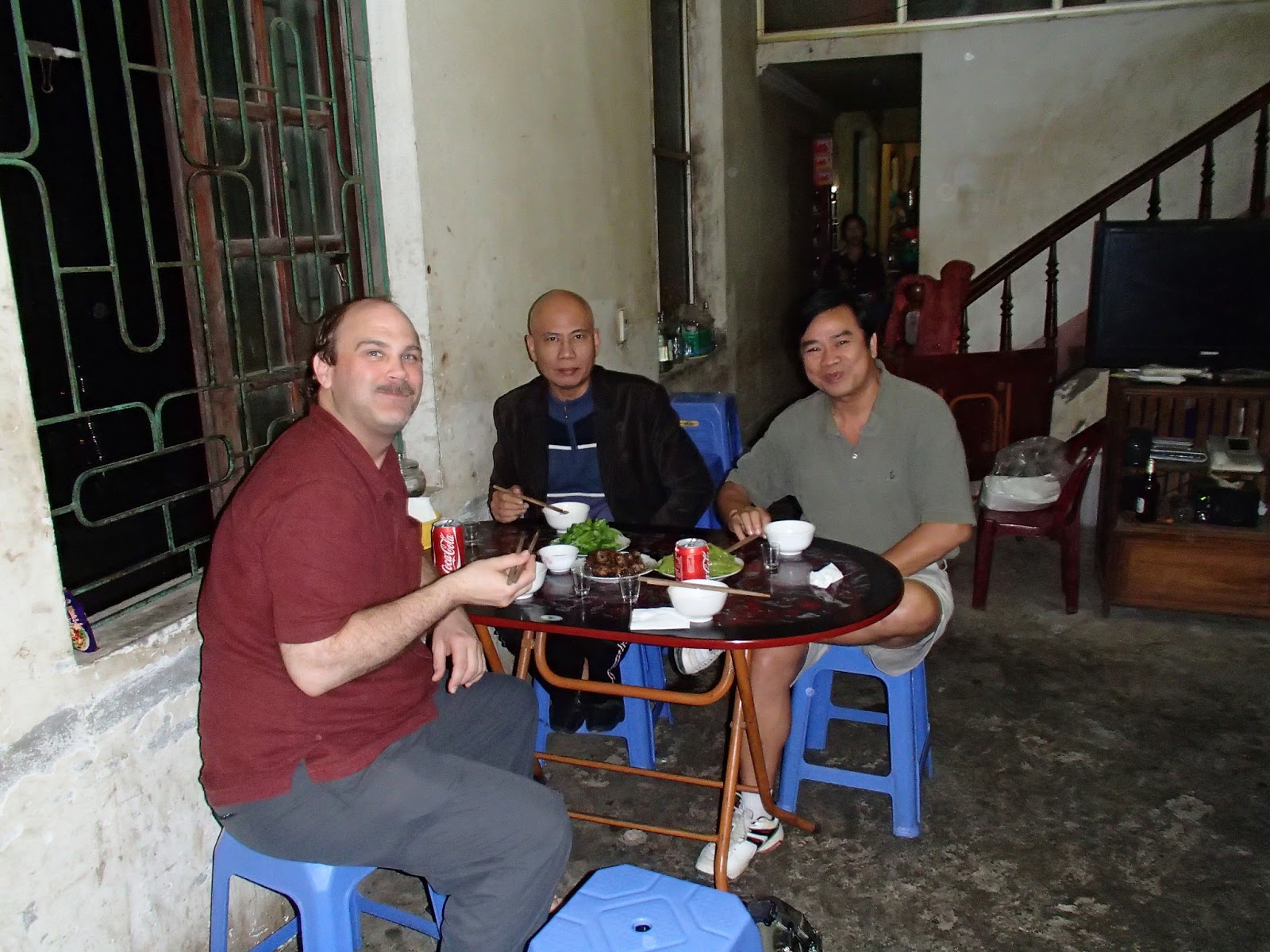
We walked back to the hotel and rested for a few minutes before meeting Cuong in the lobby at 7 o'clock. He said he had found a good place for dinner, and we walked to Nha Hang Tien Nhi restaurant. Tourists were being turned away at the door because there was no room. But when we peeked inside, we saw Mr. Giang saving a table for us, wearing a sport coat and brandishing a bottle of rice wine he had gotten at the guest house.
We took our seats and the waitstaff immediately brought plate after plate of food. Cuong had ordered "whatever is local and good." You can never go wrong with that attitude, and it all turned out to be delicious. We were served pork, pea pods, sausage, beef, greens, bamboo shoots, rice, and a type of jungle vegetable that is gathered by the Tay people. I especially liked the sausage, which reminded me of kielbasa We had a couple of rounds of chuc suc khoe rice wine toasts, and the local tourists at the next table took photos of us. At around 8 o'clock, the Dictator sent us on our way back to the hotel to bed, and the locals jokingly sang us a lullabye as we left.
 |
| Breakfast at Pho Co Cafe |
 |
| Dong Van Sunday market |
 |
| Dong Van Sunday market |
 |
| Dong Van Sunday market |
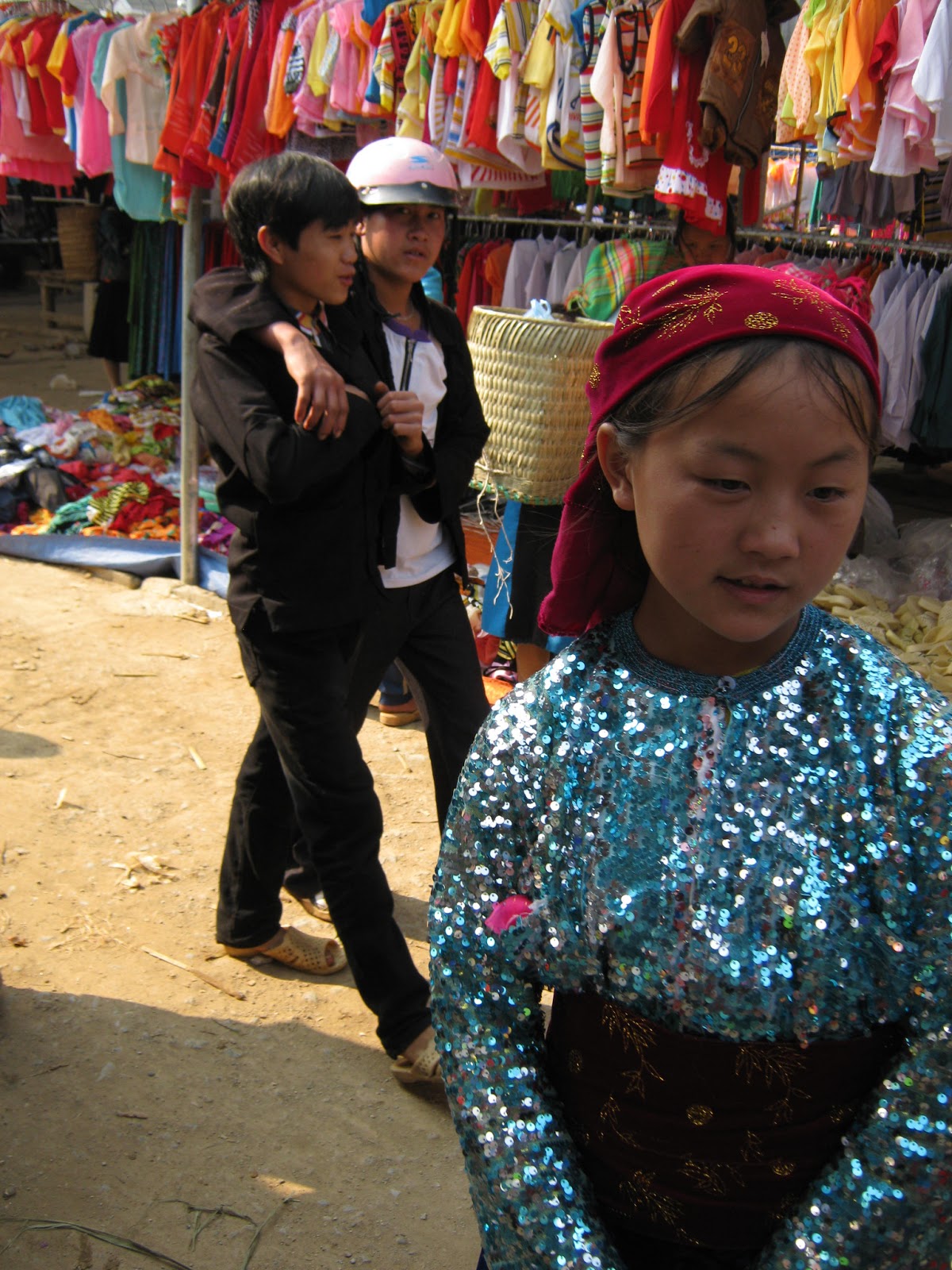
Today was Sunday, which meant that the weekly market was taking place. We walked over to the market, which was a sea of people in brightly colored clothing. Many different ethnic minorities were represented here. People walked into Dong Van town from outlying villages in the mountains to socialize as well as do their weekly buying and selling. There were few western tourists here. Men and women were engaged in various transactions, selling everything from fresh fruits and vegetables to ubiquitous white plastic flip-flops, to brightly colored clothing, to British soccer team decals, to tobacco, to cell phones. A Hmong man purchased a large locking wooden box which he hoisted onto his shoulder to carry home. Kids were eating fruit, noodles, and orange popsicles. Shiny clothing sparkled in the early morning sunlight. The colors were like a kaleidoscope.
 |
| Counting money at the Dong Van Sunday market |
 |
| A couple of ladies enjoy bananas at the Dong Van Sunday market |
 |
| Woman at Dong Van Sunday market |
 |
| Dong Van Sunday market |
 |
| Dong Van Sunday market |
Cuong let us spend as much time as we wanted here. We were very comfortable wandering around on our own, taking photos. Nobody even tried to sell us anything...how often does that ever happen in a market?
We could have people-watched here all day, but it was time to move on. After checking out of the hotel, we drove through some amazing landscapes. We could see karst limestone pinnacles rising up from the earth at different depths, each appearing to be a different shade of gray. It was very beautiful to be among these mountains.
 |
| Karst pinnacles |
 |
| Mr. Giang and the Toyota Innova |
We stopped in Sa Phin to visit Vuong Palace, former home of the Hmong King Vuong Duch Chinh.
He signed a treaty with the French at the beginning of the 20th century, and thereafter became known as the king of the White Hmong.
A young woman guided us around the property. We crossed under a welcoming archway, and then climbed a set of stairs to the unassuming entrance. Little boys were playing on the stairs, sliding down the edge of the staircase on their bottoms. There were a lot of pine trees on the property. We had only really noticed pine trees on this morning's ride. They certainly weren't abundant any place else we had been so far.
There was much Chinese influence in the architecture of this place, built in 1914.The palace itself was built of wood and stone, and had three courtyards. Wooden columns sat on granite footings carved to look like poppies. (The royal family had prospered greatly from the opium trade at the time.)
We wandered from one courtyard to the next, into and out of rooms, admiring the elaborate wood carving along the ceiling rafters. Wood was joined together perfectly, and the details were amazing. Some of the rooms contained antique furniture. The Hmong king had three wives, and they each had separate bedrooms. Two of the bedrooms contained traditional fireplaces like we had seen in Tay houses, but one contained a European style fireplace. One of the courtyards contained a half-moon shaped bath tub which was carved from a single piece of rock. This is where the king had soaked his body in goat's milk.
 |
| Voung Palace entrance |
 |
| Vuong Palace courtyard |
 |
| Vuong Palace |
Cuong made all of the arrangements and we were happy to hear that the guest house had room for the four of us. As we passed over the mountains, we stopped at Heaven's Gate (elevation 1100 meters) at a little shop which sold traditional medicine and remedies such as bags of mushrooms and satin sachets filled with cedar. We had coffee there, and Cuong bought his wife a cedar tub for soaking her feet after a long day at work, similar to the ones we had soaked in at the guest house.
As we headed back down from Heaven's Gate, Craig wasn't bothered by the car motion; he had taken his motion sickness medication today. We reached some road construction. It must be very challenging to fix these mountain roads and still keep them passable. Traffic was stopped in both directions and we got out of the car and talked to a local guide whom we had met at Heaven's Gate. After a few minutes, we were able to proceed.
As we approached Ha Giang City, the late afternoon light rendered the mountains very pretty. We came upon a muddy rice paddy where a young woman and her mother-in-law were plowing with water buffalo. The young woman had a radiant smile. She looked very delicate and it seemed incongruous to see her doing this difficult manual labor. She slogged through the mud behind her buffalo as a baby buffalo looked on. Cuong talked to her and her mother-in-law, and we took some photos.
 |
| Young woman smiles as she plows with her water buffalo |
It was a short drive from here back to the guest house, and we were greeted by the two caretaker ladies like long lost friends. The dog remembered us as well. The guest house was full tonight; there was a group of 12 French tourists. Despite all of the little curtained-off "rooms" around the perimeter, the guest house still seemed very large. Tonight we were in the curtained area that last time had been Cuong's "dictator suite." Craig and I dropped off our luggage and then headed outside to take some photos in the late afternoon light. We were very comfortable here walking around by ourselves. We ran into Chuong's mother, carrying two baskets of cabbage hanging from a pole slung over her shoulder, and smiling at us with her dyed black teeth.
 |
| Chuong's mother carries vegetables |
 |
| Woman weeding her rice paddy in the setting sun |
We walked back toward the guest house. As we passed the house next door, someone waved us over. We walked over to the house and saw that it was Chuong, our hiking guide! He was happy to see us, and greeted us warmly. He was tending a still where he was producing rice wine. Was he the source of the rice wine that we had procured from the guest house? Craig and I laughed as we recalled the TV show "Moonshiners", and realized we had just stepped into an episode. He was in a little outdoor kitchen which had a cement stove heated by a fire stoked with bamboo poles. A metal still sat on top of the stove.and clear liquid dripped into an old white plastic water jug. Chuong collected a bit in the plastic cap and gave it to Craig to drink. "Chuc suc khoe!" Next he collected some for me. It was still warm and very smooth. Such hospitality!
 |
| Chuong pours us some rice wine straight from his still |
He waved for us to go into his house. We walked under the house and he pointed us toward a blue plastic bucket that contained the mash for the brewing process. Chickens were scurrying around. His mother heard us talking and looked down the stairs from the main level of the house. She looked startled to see us in her house, but was very hospitable and friendly. She waved us up the stairs. We took off our shoes and entered. She offered us a seat at a small table, and she poured us each a cup of tea. She directed our attention to some military honors hanging o the wall. We had seen these in all of the homes that we had visited. Everyone's family was impacted by the war.
 |
| Chuong's mother serves us tea |
Chuong was able to take a break from brewing, and he came up to sit with us. He initiated conversation without a common language. He wrote on a scrap of paper "1971" and then pointed to himself. Wow, he was four years older than me. The Vietnamese certainly age well. He looks very youthful. Craig wrote down his birth year, and I wrote down mine. A friend of Chuong's entered the house and laughed with surprise when he saw the two of us sitting there. Chuong worked out some numbers by counting on his knuckles and then said something in Vietnamese to his friend. The friend knew a little English, and wrote "horse" on the piece of paper, pointing to Craig. He wrote "cat" and pointed to me. These were our signs in the Vietnamese zodiac. Chuong showed us the military honors that the father he had never known had posthumously received. He pointed out some pictures of his mother when she was younger, and ran to one of the sleeping areas to retrieve a metal necklace that he had fashioned for his mother.
 |
| Chuong pours us a mysterious drink |
Through a kind of sign language, Chuong asked us how many children we have. We answered that we don't have any children. He looked solemn. Then he got a flicker in his eyes and he jumped up and dashed back to the sleeping area. He returned with a key. Though these houses have no way to be locked up, the family had a large armoire which had locking cabinet doors. He unlocked one and extracted a glass jar. There was a large gray mass in it, and the bottom half inch of the jar contained a clear liquid. Chuong picked up the jar and poured the liquid out into three shot glasses, using his hand to hold back the gelatinous gray mass. This jar had probably once been full of clear liquid, but now it was down to the dregs. He gave us each a shot glass and the three of us toasted and drank it. It was much sweeter and more pleasant than we had anticipated. He tried to pour a second round, but there was only enough liquid for two shots. He insisted that Craig and I take it, and we toasted one another and knocked it back.
We had no idea what the gelatinous mass had been. At first it had looked like a lump of clay. Then upon further inspection, it looked like a preserved organ, like a bloated heart. Chuong indicated that this was going to provide strength, to remedy our...lack of children, if you know what I mean. We all got a good laugh but we were touched by the fact that he shared the last of this obviously precious and scarce family resource with us in an effort to help us. These villagers are beyond generous.
We knew that Chuong probably needed to get back to his brewing, so we thanked him for the hospitality and said our goodnights. We were so glad that we had come back to this friendly village. When we got back to the guest house, Cuong poured us a cup of tea. Tables and small stools filled the center of the floor. There would be a lot of people eating here tonight. Mr. Giang poured rice wine into four shot glasses and we drank a toast. "Chuc suc khoe!" "We've just started," laughed Cuong. We even got the French tourists to do a toast. Dinner was delicious: spring rolls, egg soup, fried tofu, fish with tomato, dill, and
onion, green beans, and chicken with mushrooms and carrots. Once our hostesses had served everyone, Mr. Giang convinced them to join us for a drink. They were always very proper and shook each of our hands as they smiled widely after drinking a shot. We had a lot of laughs. We thanked Cuong for bringing us back here; this certainly beat a night in noisy Yen Minh!
 |
| Chuc suc khoe! |
 |
| Mr. Giang and Craig toast |
The next morning, we had breakfast at 7 o'clock. We had fried eggs, crepes, bananas, persimmons, baguettes, Laughing Cow cheese, ramen noodles, and coffee. Shortly before 8 o'clock, Chuong arrived to take us on a hike. We walked through the paddies, saying hello to everyone we met.
As we walked down a dirt road, we came across a group of men and women who were working mixing concrete and paving sections of the small village road.
 |
| Local road construction |
 |
| Rice paddy, detail |
 |
| Rice paddies |
We passed an empty area containing stalls which must be used as a market. on other days of the week. We walked past an elementary school. A group of children in school uniforms were collecting river water in a bucket. They smiled and said hello, and asked where we were from. We passed more rice fields and gardens where residents were growing vegetables. Two women sat next to a bicycle on which was balanced a wooden tray of raw meat. It was a mobile butchery. Several houses we passed had pool tables on the ground floor.
Around halfway through our walk, the dog discerned that we were going too far and that we would probably be picked up and driven back to the guest house. He decided to head back early. Chuong told us it's because the dog doesn't like riding in vehicles.
We came to an area which had obviously been cleared for construction. We were told that a new freeway would be built that would extend from China southward. There was some heavy equipment here, and electrical poles had already been installed. This was road construction of a whole different league than we had seen local villagers mixing concrete earlier this morning. We couldn't help but wonder what this "progress" means for this little community. Will they be able to maintain their bucolic farming lifestyle, or will they become a rest stop on the freeway?
We passed some men who were shaping tree trunks into squared off beams using a chainsaw.
We passed another school, and every person we came across was friendly. We saw one man dressed in olive drab who was using a gas-powered plow to till his field.
We stopped at a small store . We sat down with the proprietor for some tea. He was smoking tobacco through a wooden water pipe. A mom and baby were upstairs peeking down at us through gaps in the floorboards. "Xin chào" we called.
After moving on from our tea break, we passed a house that was under construction. A man was working on the wooden framing, and many palm leaves were drying in bunches to be used later as thatched roofing. A woman in a conical hat walked an adult and a baby water buffalo down the dirt road. We crossed a small stream by hopping across rocks. At around 10:45, Mr. Giang met us in the van and drove us back to the guest house.
 |
| Grandfather and grandson |
 |
| Cuong pours tea in a local shop |
 |
| Woman walking her water buffalo |
 |
| Farewell lunch at the guest house |
 |
| Saying goodbye to our hostesses at the guest house |
We said our goodbyes and thanks to our hostesses, and we hit the road at 12:45. As we drove out of town we saw people drying piles of straw on the side of the road for making brooms. We drove through some stunning landscapes as we wove through the mountains. There were some gorgeous green rice terraces.
As we wound through the mountain roads, we came across three Yao men sitting under an arbor of bamboo off to one side of the road. One was reading from right to left in a book which contained gorgeous calligraphy, chanting. When he was done, another read from a scroll, and then lit the scroll on fire while the third man banged on a drum and a gong. Cuong explained that of the 54 ethnic groups in Vietnam, only 8 have a written language. The Yao are one of them.
Cuong asked them some questions and explained to us that they were performing a ceremony for their brother who had died. They had sacrifical offerings, including a dead pig laying in a large metal bowl. Sticks of incense smoldered. A small altar had been constructed of bamboo poles and palm leaves. Though you couldn't see it from here, they told us that the family home was right around the corner. We walked over to it and saw that half of it was an old traditional wooden Yao house, and half of it was modern and made of concrete. We met their brother, and Cuong realized that he had misunderstood them. Their brother wasn't dead, it was his birthday and they were doing a ceremony to promote health and long life. The Yao don't believe in western medicine, so traditional practices are very important to maintain. Their brother ushered us into the new half of the house, offering us a seat next to their large armoire. They gave us each a cup of tea, which was very nice. We thanked them for their hospitality, and told them that we were glad that their brother was alive and healthy. They got a lot of laughs out of our initial misunderstanding.
 |
| Yao man chants during a ceremony for his brother |
 |
| Yao man chants and burns a scroll during a ceremony for his brother |
 |
| Mountain landscape |
At 4 o'clock, we went next door to the spa building. We changed into towels and then got massages
side by side. The masseuses were small, but they were quite strong. They pushed and pulled, getting pops out of the deepest recesses of our joints. As the 45-minute massage was winding down, we could hear a third woman boiling water and soaking bundles of herbs to prepare for our herbal baths.
 |
| Herbal bath at Panhou Village Spa |
After our massages, we each got into our own personal cedar hot tub for one. It was like the bottom half of a wide cedar barrel. We could totally submerge so that only our heads were exposed. We could see the late afternoon sun lowering in the sky through large picture windows which gave us beautiful view of the hotel grounds. It was so relaxing! The masseuses brought us each a cup of tea which we balanced on the edge of our tubs.
Craig was a bit too relaxed.As he got out of the tub after our 45-minute herbal soak, he got a head rush. He tends to overheat easily and quite frankly I was surprised that he had managed to stay completely immersed in such hot water for so long. We took a cool shower to wash off the massage oils and then we got dressed. Craig had to sit down for a moment before leaving, as he was feeling a bit dizzy.
I thought that he would feel better once we got to our room, so I encouraged him to take the short walk. As we walked, Craig got dizzy and wobbly. He held onto a weak bamboo fence that obviously wouldn't hold his weight, and then fell down. I dropped my camera on the ground and scrambled to try to catch him. The three masseuses came running out and helped to pick him up off the ground. They walked us to our room. While I unlocked the door, Craig passed out for a few seconds and crumpled to the doorstep. The ladies sprung into action. One placed smelling salts under his nose while the other two picked him up. They brought him into the room and deposited him on the bed. They massaged his arms and legs and made him comfortable before heading back to the spa. We rested until dinner. A few minutes later one of the spa ladies came to the door just to make sure everything was alright. They were very sweet.
 |
| Chuc suc khoe! A dinner toast at Panhou Village |
At quarter past seven, we headed down the path toward the dining room. When we arrived there, Cuong and Mr. Giang were waiting for us. There was apparently one dinner seating (at 7:30) as it seemed all of the other guests were also gathering to eat at this time. Craig had a Tiger beer and I had a screwdriver. Mr. Giang had brought some rice wine and we had a few toasts. Each table got its own family-style servings of the the night's menu: two different styles of pork, cabbage, and rice. We had flan for dessert.
Cuong told us that we would be leaving bright and early in the morning for Sa Pa, so we said our goodnights and walked back to our room. As we walked through the hotel grounds down a lit garden path, we could hear frogs croaking in the quiet stillness of the night.